Signed jerseys folded in plastic bins, ticket stubs in labeled envelopes, championship newspaper pages sandwiched between old magazines, and posters rolled inside cardboard tubes mean most sports memorabilia lives in storage rather than on walls.
Wall space is where these items actually work by starting conversations, marking milestones, and making a room unmistakably yours. From a single framed poster to a full team-color gallery wall, there are five approaches worth knowing. All of them are beginner-friendly, low-cost, and achievable in a weekend afternoon.
1. Frame Vintage Game Posters and Schedules
Vintage event prints, season schedules, and bobblehead night flyers start flat and stay ready for immediate display. They serve as the easiest jumping-off point for any sports memorabilia display ideas involving flat paper goods. Standard promotional posters and season schedules almost always arrive printed at standard 18×24 inches.
Matching the frame to the print size allows the display to practically construct itself without cutting custom mats. Utilizing sleek 18×24 picture frames for sports display from Americanflat provides an exact match for standard promotional prints.
These options typically include pre-attached hanging hardware so a framed schedule can go on the wall the same afternoon it arrives.
Adding a wide mat of three to four inches between the poster and the frame edge shifts the focus onto the print itself against a dark or neutral background. Prolonged exposure to standard interior and window sunlight causes irreversible damage to vintage inks. Selecting replacement frames with UV-blocking covers provides a necessary barrier against that daily degradation.
2. Build a Framed Ticket Stub Collage
Ticket stubs remain a vastly underused format in sports fan room decor simply due to their layout. Their small footprint pushes them into junk drawers and shoeboxes for years. A whole season of tickets arranged in a single frame tells a compound story at a glance that individual tickets cannot match.
The layout process requires a clear organizing principle like chronological order, specific historic seasons, or particular venues. Arranging them on a backing card inside an 11×14 or 16×20 housing works well for groups of ten to twenty individual stubs. Archival-safe adhesives or corner mounts prevent the acid damage and sticky residue left behind by standard household tape.
Writing dates, venues, and penciled-in scores beneath each stub turns the showcase into a personal timeline rather than a plain collage.
When framing game tickets that have uneven thickness or texture variation, a deep-set shadow box allows necessary interior spacing. This gap prevents the front glass or acrylic from crushing the delicate paper fibers over decades of display.
| Pro Tip: When assembling a ticket stub collage, use archival-safe adhesive or corner mounts tape can damage paper and leave residue over time. |
3. Showcase Jerseys and Equipment in Display Cases
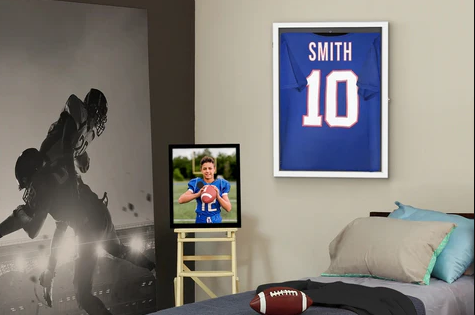
A mounted jersey transforms a plain surface into a focal point by introducing physical texture and noticeable dimension. Fabric signatures stay visible without the fading caused by heavy folding or improper closet storage.
Four containment types cover most physical sporting gear situations. Wall-mounted jersey enclosures preserve fabric while championship ring setups isolate a centerpiece item into a distinct display.
Sports ball stands keep signed custom items level on open shelves, and horizontal bat displays give game-used hardwood a safe resting place above eye level.
Protecting these items requires a controlled baseline home environment away from fluctuating vent drafts. The recommended environmental standard for preserving sensitive materials hovers between 35 and 65 degrees Fahrenheit with 30 to 50 percent relative humidity.
UV-resistant front panels further slow fabric fading and ink breakdown for equipment carrying high monetary or sentimental weight.
4. Frame Championship Newspaper Front Pages
Championship newspaper front pages operate as primary historical documents documenting specific franchise milestones. They carry printed headlines, wire photos, and box scores that digital screenshots never fully capture. These dated pages grow increasingly difficult to source and replace years after a title run happens.
Sizing varies drastically by publication format and printing press type. Broadsheet front pages typically measure up to twelve by twenty-two inches, whereas tabloid layouts run closer to 11×14 dimensions. Using a slightly oversized housing with a custom-cut mat prevents the edge creasing caused by forcing large broadsheets into tight factory spaces.
Acid-free backings and UV-filtering front covers are strictly non-negotiable because cheap newsprint yellows and turns brittle surprisingly fast. Proper isolation treatment keeps thin paper items in a usable condition for several centuries rather than falling apart in fifty years.
Three championship front pages spaced evenly across a hallway wall build a clean sequential timeline of a franchise’s greatest moments.
5. Build a Team-Color Gallery Wall
Fans holding five or more printed items benefit most from a gallery wall layout approach. This arrangement unifies separate schedules, team photos, and art prints into one intentional composition instead of scattering them across multiple rooms. Distinct team colors act as the main visual anchor, tying the disparate framed pieces together.
The initial layout step relies on choosing one consistent finish matching the team tone across all the varied items. Varying the physical sizes of the prints creates a specific visual rhythm across the blank space.
Anchoring the whole layout with one large 18×24 centerpiece allows the smaller ticket collages and medium team photos to orbit the main focal point naturally.
Layering in specific abstract team-color art prints between the memorabilia pieces adds visual contrast without injecting unnecessary clutter. Sourcing pre-curated gallery sets with matching finishes and mat hardware reduces the decision fatigue associated with mapping out a blank wall.
| Key Insight: One consistent frame finish black, gold, or white is the single decision that turns a mixed memorabilia wall from cluttered into curated. |
The Bottom Line
Every tactic listed solves the problem of deteriorating equipment packed away out of sight in attics and bins. Ready-to-hang perimeter frames sized to standard layout dimensions pull rolled paper out of tight delivery tubes.
Purpose-built jersey enclosures and custom ball stands keep valuable signed gear from fading, creasing, or collapsing against closet floors.
Baseline physical preservation matters just as much as layout aesthetics for any documented fan memorabilia. Shatter-resistant acrylics, acid-free mats, and UV-blocking panels maintain the structural integrity of thin newsprint and heavily autographed textiles over decades.
Applying a single matching finish across three or four pieces creates the clear division between a curated collection and a haphazard shelf.