
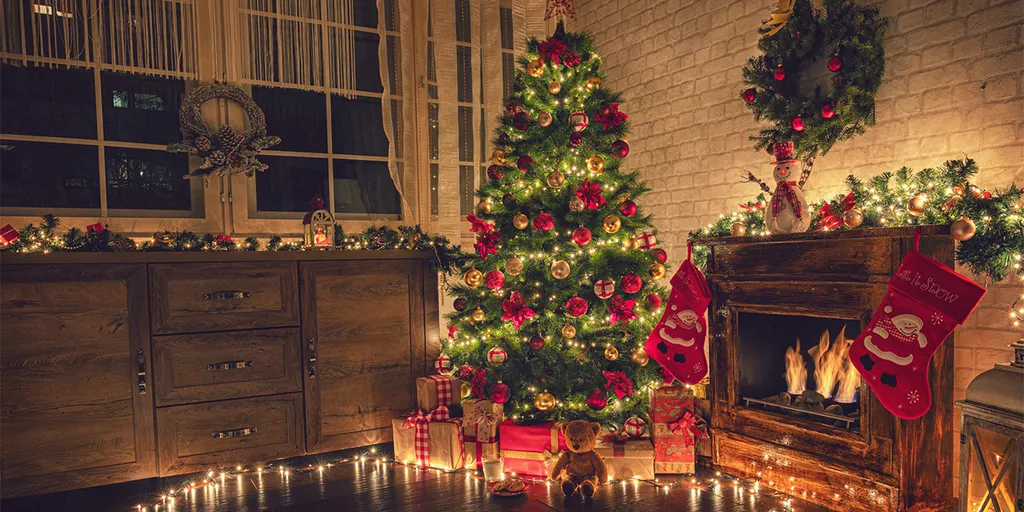

The Christmas tree has quietly become a design object. What was once a standard green triangle with whatever ornaments survived the loft is now styled, colour-matched and, for a growing number of households, chosen with the same care as a piece of furniture.
Here is what is actually happening in living rooms this season.
1. Slim Is Winning
Pencil and slim trees have moved from a compromise for small flats to a deliberate choice in large rooms. A 7ft slim tree reads as elegant and architectural, takes up a fraction of the floor space, and suits the narrower proportions of a lot of modern homes.
They also solve the perennial problem of the tree that dominates a room from mid-November onwards.
2. Two Trees, Not One
The second tree has gone mainstream. A main tree in the living room, a smaller one in the hallway, kitchen or a child’s bedroom. Often the second tree carries the chaotic, sentimental, handmade decorations while the main tree gets the curated palette, which neatly resolves a long-running domestic argument.
3. Flocked and Frosted
Snow-dusted and heavily flocked trees have had a strong couple of seasons, helped by how well they photograph against dark walls. The look is dramatic and distinctly less traditional, and it pairs best with simple decorations in a tight palette, because a flocked tree is already doing a lot of work.
4. Warm White Over Everything
Cool white lighting had a long run and is now firmly in retreat. Warm white, and increasingly very warm amber-toned lighting, dominates. It is more flattering, it reads as candlelight rather than fluorescent, and it sits better with the wood and natural textures that run through most current interiors.
Multicolour, meanwhile, is enjoying a nostalgic revival in a specific corner of the market, usually among people deliberately leaning into the Christmases of the 1980s.
5. Heritage Shapes
Sparser, more naturalistic trees that look like something you might actually find in a forest are gaining ground against the perfectly dense cone. The appeal is that gaps between branches let ornaments hang properly and the whole thing looks less manufactured.
It is a trend with deep roots. The British Christmas tree tradition is usually traced to the mid-nineteenth century and the influence of the royal household, and the history of how the tree entered British homes is a reminder that the perfectly symmetrical tree is a relatively recent invention.
6. Buying for the Long Term
The disposable artificial tree is losing favour. Shoppers are asking about tip counts, branch construction and replaceable light sections, because the understanding has taken hold that a tree is only a good purchase if it lasts ten or fifteen years.
That has pushed average spend up and pushed the cheapest end of the market down. Anyone comparing options will find it useful to look at artificial trees across a range of heights and styles with the specifications visible, since the construction details are where the long-term difference lies.
7. Decorating Earlier
The tree goes up earlier every year, and the mid-November tree is no longer unusual. Retailers report that the artificial tree season now runs from early October, partly because the best stock sells out and partly because people have decided that six weeks of a lit tree in a dark month is simply a good idea.
What It Costs to Keep Up
The flip side of treating the tree as a design object is that trends move and decorations date. The households managing this best tend to keep a neutral, long-lived tree and change only the decorations, which is far cheaper than replacing the whole thing every time the palette of the moment shifts.
A plain green tree in a classic shape will carry a brass-and-burgundy scheme one year and an icy white one the next. A heavily flocked or coloured tree commits you to a much narrower range of looks, which is worth thinking about before you buy if you are the sort of person who likes to change things.
The Second-Hand Angle
A genuine countertrend worth noting is the growth of second-hand artificial trees on resale sites, driven by both cost and environmental thinking. Because the environmental case for an artificial tree depends almost entirely on how many years it is used, buying one that already exists and giving it another decade is comfortably the lowest-impact option available.
The practical advice is to check photographs of the tree assembled rather than boxed, confirm the number of sections and that the stand is included, and assume any integrated lights may not have long left.
The One Thing Everyone Forgets
Amid all the styling, the practical point that gets overlooked every single year is electrical safety. Decorative lighting is the most common seasonal fire risk in the home, and the causes are predictable: overloaded sockets, damaged cables, lights left on overnight, and extension leads doing more than they were designed to.
Check every set before it goes on the tree. Replace rather than repair anything with damaged insulation. Switch off at night and when the house is empty. London Fire Brigade publishes a short seasonal checklist that takes two minutes to read and covers everything that actually matters.
Toppers Are Having a Moment
The final flourish has become a design decision in its own right. The traditional angel and star still dominate, but oversized bows in velvet or tartan have surged, along with sculptural wire stars and simple foliage sprays that read as deliberately understated.
The practical consideration most people discover too late is weight. A heavy topper on a slim tree is a genuine stability problem, and a tall topper on a tree already close to the ceiling leaves nowhere for it to go. Measure before you commit.
The Skirt Has Been Replaced
Tree skirts are quietly being displaced by collars and baskets. A woven basket or a metal collar around the base hides the stand, looks more considered, and does not require arranging every time someone walks past it.
It is a small change that makes a disproportionate difference to how finished a tree looks, particularly in photographs, where a crumpled skirt and a visible extension lead have ruined more otherwise good tree pictures than any other single detail.
Smaller Trees for Smaller Spaces
Tabletop and half-height trees have grown steadily, driven by flat-dwellers, students and anyone whose living room cannot absorb a full-sized tree without the sofa being moved into the hall.
They also serve a second role as the tree you put somewhere unexpected: a desk, a kitchen worktop, a bedroom windowsill. Several retailers now sell them in multipacks for exactly that reason, which would have seemed eccentric a decade ago and now looks like a reasonable reading of how people actually decorate.
Where It Lands
The through-line across all of this is that the tree has stopped being an annual afterthought. It is chosen deliberately, kept for years, styled to a palette and photographed extensively.
Whether that represents progress or simply another thing to feel mildly competitive about is a matter of personal temperament. Either way, the green triangle with the tinsel is no longer the default, and it is not coming back.