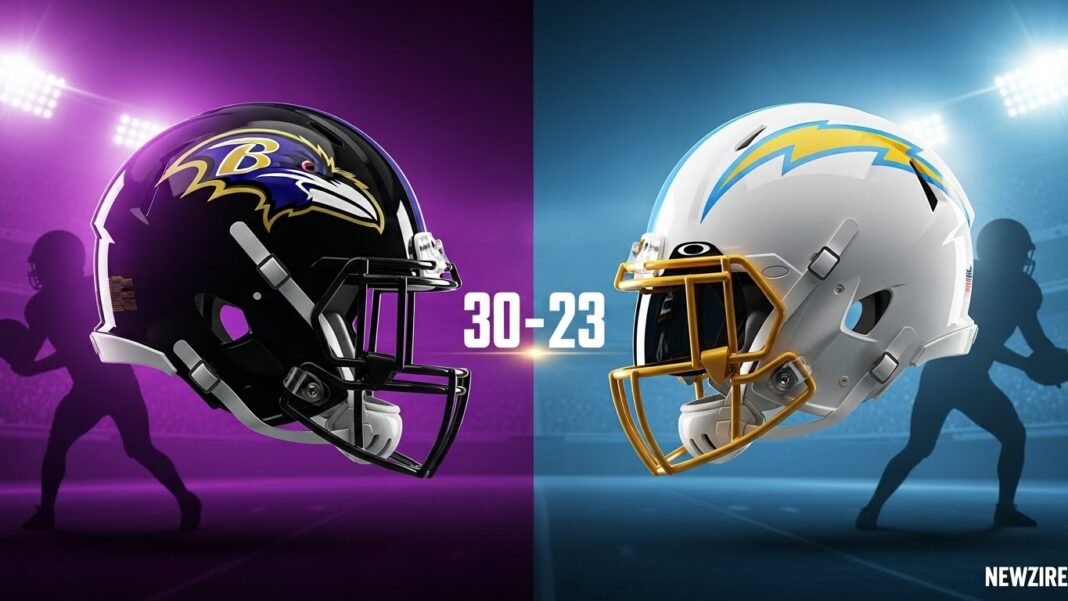
Baltimore erased a 10-0 deficit and beat Los Angeles 30-23 at SoFi Stadium on Monday Night Football, November 25, 2024. After J.K. Dobbins left with a second-quarter knee injury, the Ravens controlled both lines of scrimmage. Baltimore outgained the Chargers 389-285, held possession for over 30 minutes, and went 54 minutes between allowing touchdowns.
Table of Contents
Game Leaders: Ravens vs Chargers
| Category | Ravens Leader | Stats | Chargers Leader | Stats |
|---|---|---|---|---|
| Passing Yards | Lamar Jackson | 177 yards, 16-22, 2 TD | Justin Herbert | 218 yards, 21-36, 0 TD |
| Rushing Yards | Derrick Henry | 140 yards, 24 carries | J.K. Dobbins | 40 yards, 6 carries |
| Receiving Yards | Zay Flowers | 62 yards, 5 catches | Ladd McConkey | 83 yards, 6 catches |
| Tackles | Malik Harrison | 13 total, 7 solo | Daiyan Henley | 10 total, 4 solo |
| Sacks | 4 players tied | 1.0 each | Derwin James Jr. | 1.0 |
Team Statistics
| Stat Category | Baltimore | Los Angeles |
|---|---|---|
| Total Yards | 389 | 285 |
| First Downs | 19 | 19 |
| Third Down | 8-15 (53%) | 5-14 (36%) |
| Fourth Down | 3-3 (100%) | 2-2 (100%) |
| Time of Possession | 30:57 | 29:03 |
| Penalties | 9-102 | 7-62 |
| Turnovers | 0 | 0 |
Quarterback Performance
| Player | Team | Comp/Att | Yards | TD | INT | Sacks | Rating | Long |
|---|---|---|---|---|---|---|---|---|
| Lamar Jackson | BAL | 16-22 | 177 | 2 | 0 | 1 | 126.5 | 40 |
| Justin Herbert | LAC | 21-36 | 218 | 0 | 0 | 4 | 75.9 | 19 |
Jackson improved to 7-2 in Monday Night Football starts with 22 passing touchdowns and zero interceptions across those nine games. His 124.3 career passer rating on Monday nights ranks as the best in NFL history for quarterbacks with at least five starts, according to NFL.com.
Herbert took four sacks and added a 5-yard rushing touchdown in the opening quarter, but couldn’t find the end zone through the air all night.
Rushing Statistics
| Player | Team | Carries | Yards | Average | TD | Long |
|---|---|---|---|---|---|---|
| Derrick Henry | BAL | 24 | 140 | 5.8 | 0 | 27 |
| Justice Hill | BAL | 4 | 55 | 13.8 | 1 | 51 |
| Lamar Jackson | BAL | 8 | 15 | 1.9 | 1 | 10 |
| Mark Andrews | BAL | 1 | 2 | 2.0 | 0 | 2 |
| J.K. Dobbins | LAC | 6 | 40 | 6.7 | 0 | 17 |
| Justin Herbert | LAC | 4 | 29 | 7.3 | 1 | 12 |
| Gus Edwards | LAC | 9 | 11 | 1.2 | 1 | 8 |
| Hassan Haskins | LAC | 1 | 3 | 3.0 | 0 | 3 |
Henry racked up 101 yards after contact against a Chargers run defense ranked 10th in the NFL entering Week 12. His physical running wore down Los Angeles, setting up Justice Hill’s 51-yard fourth-quarter touchdown that sealed the game.
Receiving Statistics
| Player | Team | Receptions | Targets | Yards | Average | TD | Long |
|---|---|---|---|---|---|---|---|
| Ladd McConkey | LAC | 6 | 6 | 83 | 13.8 | 0 | 19 |
| Zay Flowers | BAL | 5 | 8 | 62 | 12.4 | 0 | 25 |
| Will Dissly | LAC | 4 | 4 | 47 | 11.8 | 0 | 18 |
| Mark Andrews | BAL | 5 | 5 | 44 | 8.8 | 1 | 16 |
| Rashod Bateman | BAL | 2 | 3 | 43 | 21.5 | 1 | 40 |
| Josh Palmer | LAC | 3 | 8 | 38 | 12.7 | 0 | 17 |
| Jalen Reagor | LAC | 2 | 4 | 20 | 10.0 | 0 | 11 |
| J.K. Dobbins | LAC | 3 | 5 | 19 | 6.3 | 0 | 11 |
| Tylan Wallace | BAL | 1 | 1 | 15 | 15.0 | 0 | 15 |
| Tucker Fisk | LAC | 1 | 1 | 7 | 7.0 | 0 | 7 |
| Justice Hill | BAL | 2 | 2 | 7 | 3.5 | 0 | 9 |
| Charlie Kolar | BAL | 1 | 1 | 6 | 6.0 | 0 | 6 |
| Derius Davis | LAC | 2 | 2 | 4 | 2.0 | 0 | 3 |
McConkey led Los Angeles receivers with 83 yards on six catches. Quentin Johnston dropped three catchable passes, including a crucial third-down opportunity late in the fourth quarter.
Defensive Leaders
| Player | Team | Position | Tackles | Solo | Sacks | TFL | QB Hits | PD |
|---|---|---|---|---|---|---|---|---|
| Malik Harrison | BAL | LB | 13 | 7 | 0 | 1 | 0 | 0 |
| Daiyan Henley | LAC | LB | 10 | 4 | 0 | 1 | 0 | 0 |
| Nick Niemann | LAC | LB | 8 | 4 | 0 | 0 | 0 | 0 |
| Tarheeb Still | LAC | CB | 7 | 4 | 0 | 0 | 0 | 0 |
| Nate Wiggins | BAL | CB | 6 | 6 | 0 | 0 | 0 | 2 |
| Derwin James Jr. | LAC | S | 6 | 2 | 1 | 0 | 1 | 0 |
| Poona Ford | LAC | DT | 5 | 3 | 0 | 0 | 0 | 0 |
| Ar’Darius Washington | BAL | S | 4 | 4 | 0 | 0 | 0 | 0 |
| Chris Board | BAL | LB | 4 | 2 | 0 | 0 | 0 | 0 |
| Joey Bosa | LAC | DE | 4 | 3 | 0 | 1 | 0 | 0 |
| Khalil Mack | LAC | DE | 4 | 3 | 0 | 0 | 1 | 0 |
Harrison filled in admirably for Roquan Smith, who missed the game with a hamstring injury. The Ravens defense recorded four sacks and seven quarterback hits while holding Los Angeles to 83 second-half yards.
Special Teams
| Team | Kicker | FG Made/Att | Long | XP Made/Att | Punter | Punts | Average |
|---|---|---|---|---|---|---|---|
| Baltimore | Justin Tucker | 1-1 | 45 | 3-3 | Jordan Stout | 3 | 54.3 |
| Los Angeles | Cameron Dicker | 3-3 | 52 | 2-2 | JK Scott | 4 | 41.3 |
Dicker connected twice from 52 yards, showing off his leg strength on field goals at the end of each half. Derius Davis returned one kickoff for 46 yards and one punt for 19 yards.
Fourth-and-Guts: The Call That Changed Everything
Fourth-and-1 from your own 16-yard line. Down three points. Two minutes before halftime.
Most NFL coaches punt. John Harbaugh called for tight end Mark Andrews to take a direct snap and execute a quarterback sneak. Andrews powered forward for 2 yards, keeping the drive alive and sparking Baltimore’s comeback from a 10-0 deficit.
“I just felt like we could make it,” Harbaugh told ESPN’s Lisa Salters at halftime. “No guts, no glory, right?”
Five plays after that conversion, Jackson connected with Bateman for the 40-yard touchdown that gave Baltimore its first lead at 14-10. ESPN Stats and Info noted that no team had converted a fourth down that deep in their own territory during the first half since the 2012 Rams did so on a fake punt.
The Ravens went 3-for-3 on fourth down, also converting at their own 39-yard line and at the Chargers’ 25. Those aggressive decisions created two touchdown drives and flipped field position in critical moments.
This marked the third meeting between brothers John and Jim Harbaugh, with Baltimore’s head coach improving to 3-0. The first matchup since Super Bowl XLVII in February 2013 carried added weight for both families.
“I just told him, ‘You’re a great coach and you have a great team. And I love you,'” John Harbaugh said postgame, per NFL.com. “And he said, ‘I love you and congratulations.’ It was good.”
How Baltimore’s Offense Dominated
The Ravens’ success started with winning the line of scrimmage. Henry averaged 5.8 yards per carry across 24 attempts, moving the chains and setting up manageable second-down situations. Those favorable downs allowed offensive coordinator Todd Monken to attack Los Angeles’s secondary with play-action.
The Chargers stacked the box to stop Henry, leaving Baltimore’s receivers in single coverage. Jackson attacked that look by completing passes of 40, 25, 22, and 16 yards to different receivers.
Efficiency on third down separated these teams. Baltimore converted 8 of 15 attempts (53%) while Los Angeles managed just 5 of 14 (36%). While the Ravens consistently extended drives, the Chargers went three-and-out repeatedly in the second half.
Jackson hit Andrews for 16 yards on third-and-5 early in the second quarter. Two drives later, he found Flowers for 22 yards on third-and-2, then connected with Flowers again for 25 yards on third-and-10 in the third quarter. Converting third-and-10 forced Los Angeles’s defense to stay on the field, wearing them down for Hill’s fourth-quarter touchdown run.
Converting just 36% of third downs (5-14), the Chargers killed multiple promising drives. Herbert’s inability to sustain possession in crucial situations handed Baltimore complete control.
The Dobbins Injury That Shifted Everything
After gaining 40 yards on his first six carries against his former team, J.K. Dobbins exited in the second quarter with a knee injury. Without him, Los Angeles abandoned the running game. Gus Edwards managed 11 yards on nine carries, averaging 1.2 yards per attempt. Without a functional ground game, Herbert faced constant pressure and took four sacks.
“They ran the ball real well,” Jim Harbaugh said after the game. “We need better block destruction just across the board, but you’ve got to give them credit.”
Baltimore rushed for 212 yards. Los Angeles managed 83. That’s not a football game. That’s a physical beatdown.
What This Game Showed About Both Teams
The Ravens improved to 8-4 while the Chargers fell to 7-4. Those records don’t reflect how wide the gap between these teams actually is. Baltimore showed what playoff football requires, while Los Angeles got exposed against their first real test.
The Chargers had won four straight games before Monday night, but those victories came against Cleveland, New Orleans, Tennessee, and Cincinnati. When Jim Harbaugh’s squad finally faced an elite team, they folded. Beating struggling opponents is completely different from competing against legitimate contenders.
“I thought we did a good job of limiting turnovers and keeping the ball,” Herbert said, per Pro Football Reference. “We’ve just got to score more points.”
The Chargers went 54 minutes between touchdowns, managing only field goals until Gus Edwards’s 1-yard score with 46 seconds remaining.
After losing 18-16 to Pittsburgh in Week 11, Baltimore responded with physical football on both sides. The offensive line controlled the line of scrimmage for Henry’s 140 yards while the defensive front generated four sacks and seven quarterback hits.
Derrick Henry’s 140 yards on 24 carries and John Harbaugh’s gutsy fourth-down decisions powered Baltimore’s Monday night victory. John Harbaugh improved to 3-0 against his brother Jim’s teams. More importantly, the Ravens proved they belong in the AFC playoff race while exposing Los Angeles as a team that dominates weak opponents but crumbles against real competition.
For more NFL player stats and game analysis, visit Newzire.