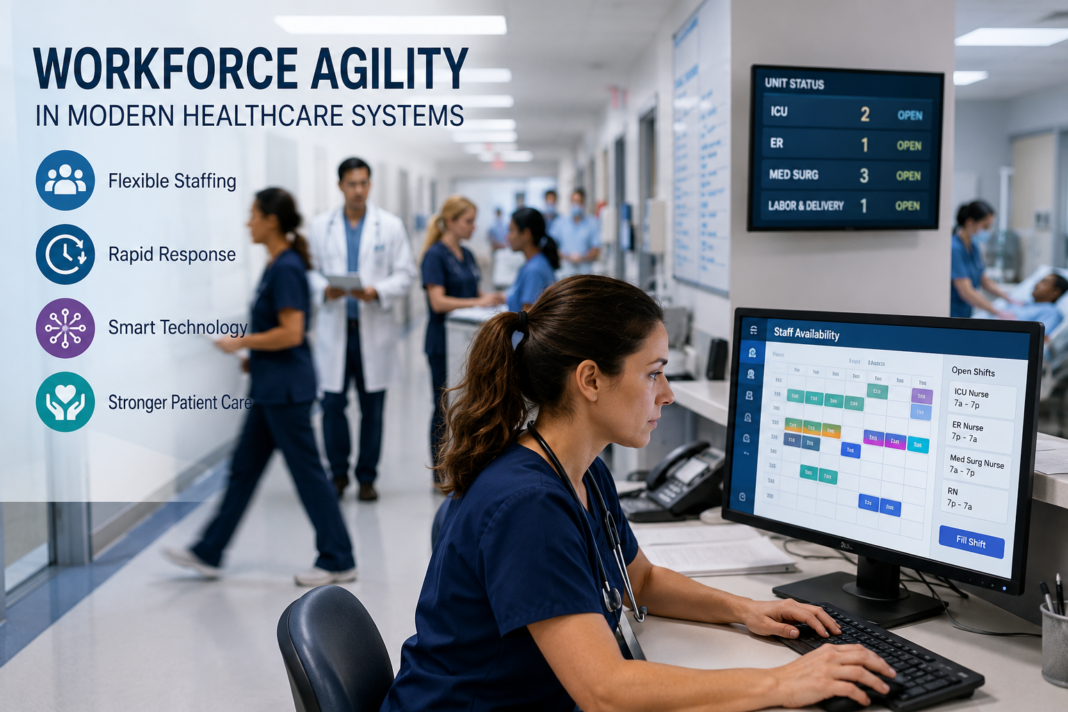
Hospitals love to talk about being nimble. It sounds great on a mission statement, right up there next to “patient-centered” and “innovative.” It sounds a lot less great at 2 am when a unit is short two nurses and the only backup plan is a phone tree from 2015 that half the staff has already muted. Healthcare moves fast in almost every direction except staffing. Scanners get smarter every year. Staffing models seem to be waiting for a memo that never shows up. That’s the real story behind workforce agility. It isn’t a buzzword for a slide deck. It’s whether a hospital can bend when real life throws a curveball, which it always does, usually at the worst possible hour.
Take a sudden staffing gap as an example. Flu season hits harder than expected, or three nurses somehow request the exact same week off without checking with each other, because apparently that’s a universal law of scheduling. A facility with real agility can pull in coverage fast, sometimes within hours. A big part of that speed comes from having a solid locums VMS platform already running instead of scrambling through emails and sticky notes that vanish the moment someone needs them. Facilities without one end up playing phone tag while patients wait, and nobody wins that game.
Why Rigid Staffing Breaks Down Fast
Traditional staffing models were built for predictable demand, back when that concept still meant something. That world barely exists anymore. Patient volume swings depending on the season, the news cycle, and honestly sometimes the weather, because apparently everyone gets hurt the same week it snows.
When staffing breaks, the effects ripple outward fast. Wait times grow. Existing staff get pulled into overtime nobody asked them about. Morale takes a hit, and burnout creeps in quicker than anyone wants to admit. None of this looks dramatic in the moment, but it piles up like tiny cracks spreading across a windshield.
Technology as the Great Equalizer
The good news is tools now exist that make agility realistic instead of aspirational. Scheduling software can match open shifts to available staff in minutes. Credentialing platforms cut down the paperwork mountain that used to eat entire weeks. These tools don’t replace human judgment, but they do steal the busywork off everyone’s plate, which feels like a small miracle to anyone who has filled out a credentialing form by hand and questioned every life choice that led them there.
Adoption remains uneven, though. Some systems jump in fast and never look back. Others hesitate, nervous about cost or the learning curve. That hesitation makes sense in a field where everyone is already stretched thin. But waiting usually costs more down the road, in both dollars and staff patience.
Building a Culture That Bends Without Breaking
Technology helps, but culture matters just as much, maybe more. Staff need to trust that flexibility won’t quietly turn into “always available, no boundaries, good luck.” The best systems balance speed with genuine respect for people’s time.
Leaders who get this right tend to explain things clearly and often. They walk staff through why a schedule shifted and give people real input into the process. That transparency builds trust, and trust makes people far more willing to adapt when something unexpected lands on their desk.
The Bigger Picture
Workforce agility isn’t some trend fading out next quarter. It’s becoming the baseline expectation in healthcare, right alongside clean facilities and charts that actually make sense. Hospitals that build real flexibility into their staffing will handle disruption with far less panic. The ones that don’t will keep relying on luck, coffee, and whoever happens to pick up the phone at midnight. One of those strategies scales. The other one just runs on fumes.