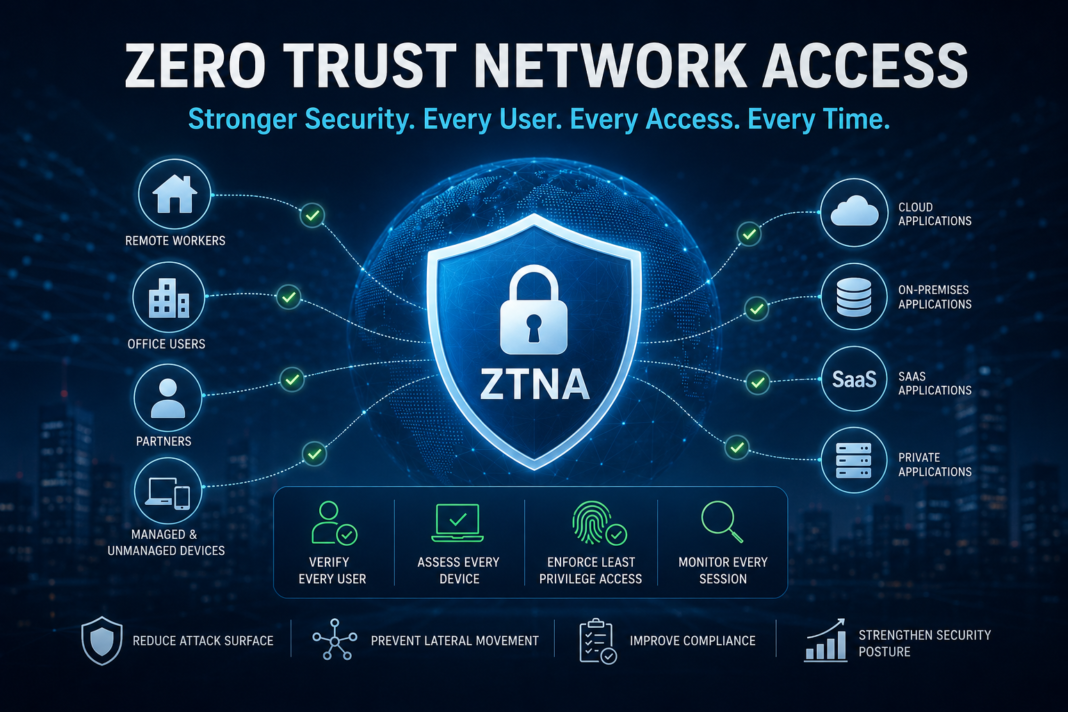
Enterprise cybersecurity has undergone a fundamental shift over the last decade. The boundaries that once defined a secure corporate environment, a physical perimeter, a managed network, and devices that never left the office have dissolved. In their place, organizations now manage workforces that access applications from homes, airports, client sites, and devices that span from corporate-managed endpoints to personal mobile devices. The security models built for the old environment are poorly suited to this new one, and the gaps they leave have been consistently and expensively exploited.
Zero-trust network access has emerged as one of the most consequential responses to this shift. For organizations evaluating how to improve enterprise cybersecurity without sacrificing the operational flexibility that distributed work requires, understanding zero trust network access for remote workforce environments is an essential starting point.
Why Perimeter Security Has Become Insufficient
The perimeter security model treats everything inside the network as trustworthy and everything outside as suspect. VPNs, firewalls, and network segmentation were the primary tools for maintaining that perimeter, and they worked reasonably well when users worked from offices, applications lived in corporate data centers, and the perimeter was a definable concept.
None of those conditions reliably holds anymore. Applications have moved to SaaS platforms and public cloud environments. Users connect from wherever they are working, on networks and devices that fall outside corporate IT control. Partners and contractors need access to internal resources without any meaningful integration with corporate security infrastructure. The perimeter is not just porous in many enterprise environments; it no longer exists as a coherent construct.
The consequences are significant. VPN credentials are among the most frequently targeted credentials in enterprise breaches, because a compromised set grants network-level access that allows adversaries to move laterally toward high-value targets. The implicit trust that perimeter security models extend to connected users becomes an attack vector the moment any credential in that system is compromised.
What Zero Trust Changes
The zero trust model eliminates implicit trust entirely. Rather than granting access based on network location, every request from every user, on every device, at every session is verified against a defined policy before access is granted. The principle “never trust, always verify” is the foundational commitment of the model, and it applies continuously throughout a session, not just at connection time.
The intellectual origins and ongoing development of this model are well documented in analyst and standards communities. The zero trust principles explained in Forrester’s foundational research trace how the concept was developed in response to exactly the failure modes that perimeter-based architectures produce insider threats, credential compromise, and lateral movement that perimeter controls cannot detect or contain.
ZTNA applies these principles specifically to the remote access problem. Rather than creating a network-level tunnel that extends broad access to a connected user, ZTNA grants access at the application level to specific applications, for specific users, verified against specific policy conditions at the time of each request.
The Cybersecurity Improvements ZTNA Delivers
ZTNA improves enterprise cybersecurity across several distinct dimensions, each of which addresses a failure mode that traditional remote access architectures cannot reliably prevent.
The most immediate improvement is the reduction in lateral movement risk. When a ZTNA architecture grants each user access only to the applications their role requires, a compromised credential provides an attacker access only to that application scope not to the broader network infrastructure. Stopping lateral movement before it begins is one of the most effective ways to limit the blast radius of a breach, and ZTNA’s application-level segmentation is structurally designed to achieve that outcome.
The second improvement is continuous verification. VPN architectures authenticate at connection time and maintain that access until the session ends. ZTNA platforms continuously evaluate session risk, monitoring signals such as device posture changes, anomalous behavior patterns, and changes in the user’s access context. A session that begins under normal conditions can be terminated or restricted automatically if risk signals change, providing enforcement capabilities that static VPN architectures do not offer.
Third, ZTNA reduces the attack surface that remote access creates. VPN infrastructure must be accessible from the public internet to function, making it a persistent target for vulnerability exploitation. Many of the most consequential enterprise intrusions of recent years began with the exploitation of VPN appliance vulnerabilities. ZTNA architectures, by contrast, do not expose internal network infrastructure to the public internet users and devices connect to application access brokers that sit in front of applications, removing the internal network from the attacker’s accessible attack surface.
Identity as the New Security Perimeter
One of the most significant conceptual shifts that zero trust network access brings to enterprise cybersecurity is the elevation of identity to the primary enforcement mechanism. In a perimeter-based model, the network location of a request is the primary signal used to determine whether to grant access. In a ZTNA model, the authenticated identity of the requesting user combined with device health, behavioral context, and access policy replaces network location as the authoritative basis for access decisions.
This shift has practical implications for how enterprise security teams structure their controls. Strong authentication, multi-factor verification, and privileged access management become foundational capabilities rather than supplementary controls. The integrity of the identity fabric of every human user, service account, and machine identity that can initiate a ZTNA session determines the integrity of the access model.
Research on how enterprise security teams are approaching identity and network access security priorities for 2026 highlights the degree to which identity has become the primary attack surface in distributed enterprise environments, with adversaries targeting credentials and session tokens as the most reliable path to accessing protected resources. ZTNA’s identity-first verification model is a direct structural response to that threat pattern.
ZTNA and Regulatory Compliance
Beyond its direct security benefits, ZTNA also improves enterprise cybersecurity by supporting compliance with regulatory requirements that mandate access control, audit logging, and data protection across enterprise systems.
Many regulatory frameworks, including those governing healthcare, financial services, and critical infrastructure, require that access to sensitive data be granted on a least-privilege basis and that access events be logged with sufficient detail to support audit and investigation. ZTNA architectures satisfy both requirements structurally. Application-level access grants ensure that users access only what their role requires, and the policy enforcement point that evaluates every access request generates a complete log of access decisions, supporting audit requirements without additional tooling.
For enterprises operating across multiple regulatory jurisdictions, ZTNA’s centralized policy management also simplifies compliance operations. A single policy framework governs access across all environments and all user populations, reducing the inconsistency that commonly leads to compliance gaps when access is managed through separate tools for on-premises, cloud, and remote users.
Deploying ZTNA in Enterprise Environments
Effective ZTNA deployment in enterprise environments typically follows a phased approach. Organizations begin by identifying the highest-risk access pathways, often third-party and contractor access, privileged user access to sensitive systems, or remote access to applications that handle regulated data and applying ZTNA controls to those pathways first.
Integration with existing identity infrastructure is a prerequisite for most ZTNA deployments. Policy decisions depend on the authenticated identity of the requesting user, which means the ZTNA platform must connect to the enterprise identity provider to evaluate user context. Integration with endpoint management tools enables device posture assessment, adding the second layer of verification that distinguishes ZTNA from simpler access control models.
Many enterprise ZTNA deployments run alongside existing VPN infrastructure during a transition period. Applications are migrated to ZTNA access one by one, with VPN access maintained for applications that have not yet been onboarded. This approach allows security teams to validate ZTNA policy and user experience before completing the migration, reducing operational risk during the transition.
The Long-Term Cybersecurity Case for Zero Trust Network Access
ZTNA is not a single product or a point solution it is an architectural approach to remote access that aligns the enforcement model with the actual threat environment enterprises face. The cybersecurity improvements it delivers are structural: they result from eliminating the implicit trust assumptions that make traditional remote access architectures vulnerable, rather than from adding detection layers on top of a flawed foundation.
For enterprise security teams evaluating how to reduce breach risk, improve compliance posture, and extend consistent security controls to distributed workforces, ZTNA represents one of the highest-leverage investments available. Its ability to limit lateral movement, reduce attack surface, and enforce continuous verification addresses the failure modes that cause the most significant and costly enterprise security incidents.
Frequently Asked Questions
How does ZTNA reduce the risk of a breach caused by compromised credentials?
ZTNA limits the access that any single credential can provide to the specific applications that the user’s policy permits, rather than granting broad network access. A compromised credential in a ZTNA architecture gives an attacker access only to those applications, and continuous session monitoring can detect anomalous activity and terminate access before the attacker can establish persistence or move laterally.
Can ZTNA be implemented without replacing existing security infrastructure?
ZTNA typically integrates with existing identity providers, endpoint management platforms, and security monitoring systems rather than requiring replacement of existing tools. Organizations commonly deploy ZTNA in phases, starting with the highest-risk access pathways and progressively migrating additional applications while maintaining existing access controls during the transition.
Is ZTNA suitable for enterprises with both on-premises and cloud-hosted applications?
ZTNA is well-suited to hybrid application environments. It provides consistent policy enforcement for applications regardless of where they are hosted, applying the same identity verification, device posture assessment, and least-privilege access controls whether the target application is in a public cloud, a private data center, or a SaaS platform. This consistency is one of the primary advantages ZTNA offers over traditional remote access architectures, which often require different tools and policies for on-premises and cloud-hosted resources.