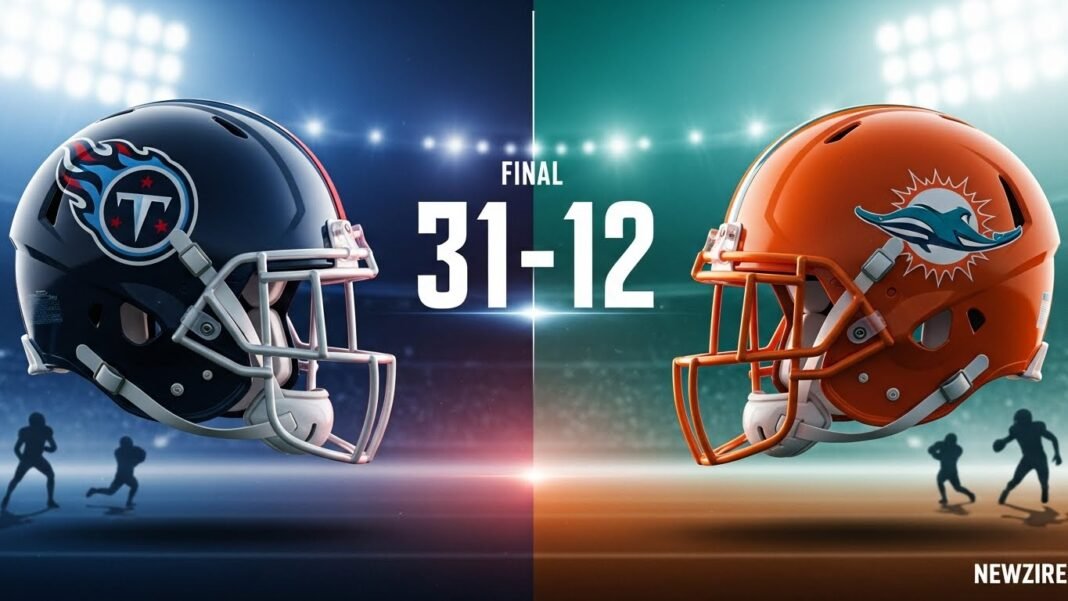
Monday night at Hard Rock Stadium belonged to Tennessee. The Titans dismantled Miami 31-12 behind Tony Pollard’s 88 rushing yards and a touchdown on 22 carries, Nick Folk’s perfect 5-for-5 field goal performance including three from beyond 50 yards, and Mason Rudolph’s steady 9-for-17 passing for 85 yards after Will Levis went down with a shoulder injury.
Table of Contents
Scoreboard and Game Information
| Team | Q1 | Q2 | Q3 | Q4 | Final |
|---|---|---|---|---|---|
| Tennessee Titans | 0 | 9 | 10 | 12 | 31 |
| Miami Dolphins | 0 | 3 | 3 | 6 | 12 |
September 30, 2024 | Hard Rock Stadium, Miami Gardens, FL | Attendance: 65,291 | Weather: 86°F, 70% humidity, 9 mph wind | Game time: 3:13
Brian Callahan earned his first victory as Tennessee’s head coach, moving the Titans to 1-3. The 31 points snapped a 38-game streak dating back 1,002 days to Week 17 of 2021, when Tennessee last reached 30 points against these same Dolphins. Miami fell to 1-3 with Tua Tagovailoa sidelined on injured reserve, creating uncertainty about the Dolphins’ offensive identity.
Quarterback Performance
| Player | Team | Comp | Att | Yards | TD | INT | Sacks | Rating |
|---|---|---|---|---|---|---|---|---|
| Mason Rudolph | TEN | 9 | 17 | 85 | 0 | 0 | 1 | 67.0 |
| Will Levis | TEN | 3 | 4 | 25 | 0 | 1 | 0 | 51.0 |
| Tyler Huntley | MIA | 14 | 22 | 96 | 0 | 0 | 2 | 73.3 |
Will Levis lasted just four pass attempts before injuring his right shoulder on a first-quarter scramble. Emmanuel Ogbah picked him off on Tennessee’s opening possession before the injury ended his night. Mason Rudolph took over and protected the ball, avoiding turnovers while Tennessee pounded the rock. His 27-yard strike to Tyler Boyd in the final seconds of the first half set up a crucial field goal that extended the lead to 9-3.
Tyler Huntley started his first game for Miami after signing off Baltimore’s practice squad on September 17. The South Florida native completed 63.6% of his attempts but couldn’t push the ball downfield. His longest completion gained just 18 yards, exposing how much Miami’s vertical attack depends on Tagovailoa’s deep-ball accuracy.
The quarterback contrast defined this game. Rudolph managed risk, Huntley couldn’t generate explosive plays, and without Tagovailoa’s anticipation, Miami’s speed weapons became ordinary.
Ground Game Statistics
| Player | Team | Carries | Yards | Average | TD | Long |
|---|---|---|---|---|---|---|
| Tony Pollard | TEN | 22 | 88 | 4.0 | 1 | 41 |
| Tyjae Spears | TEN | 15 | 39 | 2.6 | 1 | 9 |
| Tyler Huntley | MIA | 8 | 40 | 5.0 | 1 | 20 |
| Jaylen Wright | MIA | 9 | 32 | 3.6 | 0 | 20 |
| Tyreek Hill | MIA | 3 | 19 | 6.3 | 0 | 16 |
| De’Von Achane | MIA | 10 | 15 | 1.5 | 0 | 5 |
Tony Pollard’s 41-yard burst in the third quarter ripped through Miami’s front seven, positioning the Titans at the 7-yard line. Tyjae Spears cashed in two plays later, taking a direct snap from the Wildcat formation and juking Zach Sieler for a seven-yard touchdown. Tennessee accumulated 142 rushing yards on 40 attempts while controlling possession for 34:52, nearly 10 minutes more than Miami.
Tyler Huntley’s mobility kept Miami functional on the ground with a team-high 40 yards. His 1-yard touchdown plunge in the fourth quarter ended a staggering 173:03 drought without the Dolphins reaching the end zone. Rookie Jaylen Wright flashed potential with 32 yards on nine carries, including a 20-yard run that showed his burst. De’Von Achane struggled behind Miami’s patchwork offensive line, averaging just 1.5 yards per carry.
Tennessee’s commitment to the ground game wasn’t just volume, it was philosophy. The Titans called 40 rushing plays versus 21 passes, grinding clock and shortening the game while Miami’s offense sputtered.
Receiving Statistics
Tennessee Receivers
| Player | Targets | Receptions | Yards | Average | Long |
|---|---|---|---|---|---|
| DeAndre Hopkins | 4 | 2 | 31 | 15.5 | 16 |
| Tyler Boyd | 2 | 2 | 31 | 15.5 | 27 |
| Tony Pollard | 2 | 2 | 20 | 10.0 | 16 |
| Treylon Burks | 1 | 1 | 13 | 13.0 | 13 |
| Chigoziem Okonkwo | 3 | 1 | 5 | 5.0 | 5 |
Miami Receivers
| Player | Targets | Receptions | Yards | Average | Long |
|---|---|---|---|---|---|
| Jaylen Waddle | 6 | 4 | 36 | 9.0 | 18 |
| Tyreek Hill | 7 | 4 | 23 | 5.8 | 17 |
| De’Von Achane | 3 | 3 | 14 | 4.7 | 5 |
| Tanner Conner | 2 | 2 | 15 | 7.5 | 11 |
| Malik Washington | 1 | 1 | 8 | 8.0 | 8 |
Tennessee spread targets without feeding any single receiver. Tyler Boyd’s 27-yard grab over the middle with 16 seconds left in the second quarter showcased excellent clock management, allowing Mason Rudolph to spike the ball with one second remaining before Nick Folk’s 47-yard field goal.
Tyreek Hill was held under 50 yards for the third consecutive game, managing just 23 yards on four catches despite seven targets. Without Tagovailoa’s ability to hit receivers in stride on vertical routes, Hill became a possession receiver rather than a home-run threat. Jaylen Waddle’s team-leading 36 yards shows how limited Miami’s passing attack became without their franchise quarterback. Their most productive receiver gained fewer yards than Tyler Boyd on two receptions.
Miami totaled 78 passing yards, continuing their offensive struggles without Tagovailoa. The absence of explosive plays forced the Dolphins into predictable situations where Tennessee’s defense could tee off.
Defensive Performance
Tennessee Defense
| Player | Total | Solo | Assists | TFL | Sacks | QB Hits |
|---|---|---|---|---|---|---|
| Kenneth Murray Jr. | 9 | 6 | 3 | 1 | 0.0 | 0 |
| Sebastian Joseph-Day | 6 | 3 | 3 | 1 | 1.0 | 2 |
| T’Vondre Sweat | 6 | 3 | 3 | 2 | 0.0 | 0 |
| Harold Landry III | 5 | 1 | 4 | 1 | 1.0 | 2 |
| Amani Hooker | 5 | 3 | 2 | 0 | 0.0 | 0 |
| Ernest Jones IV | 5 | 3 | 2 | 1 | 0.0 | 0 |
Miami Defense
| Player | Total | Solo | Assists | TFL | Sacks | QB Hits | INT |
|---|---|---|---|---|---|---|---|
| Jordyn Brooks | 13 | 9 | 4 | 2 | 1.0 | 1 | 0 |
| Anthony Walker Jr. | 9 | 3 | 6 | 0 | 0.0 | 0 | 0 |
| Emmanuel Ogbah | 6 | 3 | 3 | 1 | 0.0 | 1 | 1 |
| Calais Campbell | 5 | 4 | 1 | 1 | 0.0 | 0 | 0 |
| Zach Sieler | 5 | 2 | 3 | 0 | 0.0 | 1 | 0 |
| Jevon Holland | 5 | 3 | 2 | 0 | 0.0 | 0 | 0 |
Jordyn Brooks finished with 13 tackles, one sack, and a pass defensed, becoming the first Dolphins player since Hall of Famer Zach Thomas in 2005 to record at least 13 tackles, one sack, and one pass defensed in a single game. His relentless motor kept Miami competitive on that side of the ball, even as the offense failed to capitalize. Brooks’ sack of Mason Rudolph in the third quarter forced a punt that set up Jason Sanders’ 56-yard field goal, temporarily cutting the deficit to three points.
Emmanuel Ogbah secured his second career interception on Tennessee’s opening drive, bobbling the ball initially before trapping it between his knees. That takeaway gave Miami excellent field position at Tennessee’s 37, but a fumbled lateral to Tyreek Hill squandered the opportunity.
Rookie T’Vondre Sweat imposed his physicality in Tennessee’s interior with two tackles for loss that disrupted Miami’s running lanes. His presence clogged gaps and forced the Dolphins into predictable passing situations. Kenneth Murray Jr. totaled nine tackles, consistently flowing to the ball carrier.
Tennessee’s defense held Miami to 2 of 12 on third down conversions, an identical rate to what the Titans converted on offense. The difference? Tennessee’s running game sustained drives through successful first and second downs, while Miami went three-and-out repeatedly.
Special Teams Excellence
| Kicker | FG Made | FG Att | Long | XP Made | XP Att | Points |
|---|---|---|---|---|---|---|
| Nick Folk (TEN) | 5 | 5 | 53 | 2 | 2 | 17 |
| Jason Sanders (MIA) | 2 | 2 | 56 | 0 | 0 | 6 |
Nick Folk delivered the game’s most dominant individual performance. His 5-for-5 night from 53, 52, 47, 51, and 29 yards matched his career high for makes while his three 50-plus yarders established a personal best. At 39 years old, Folk became the oldest kicker in NFL history to convert three 50-yard field goals in one game. His range essentially turned Tennessee’s 40-yard line into scoring territory, fundamentally altering fourth-down decisions throughout. When Tennessee crossed midfield, they had points. Miami didn’t possess that same weapon, creating a strategic advantage that widened throughout the game.
Jason Sanders connected from 44 and 56 yards. His 56-yarder in the third quarter cut Tennessee’s lead to 9-6, coming one yard short of his career long. The kick showcased Sanders’ leg strength, but Miami’s offense couldn’t generate enough possessions to make his accuracy matter.
Braxton Berrios provided Miami’s lone special teams spark, returning a punt 27 yards in the third quarter. That field position directly led to Sanders’ 56-yard field goal, but the Dolphins couldn’t sustain momentum afterward.
Team Statistics
| Category | Tennessee | Miami |
|---|---|---|
| First Downs | 16 | 13 |
| Total Plays | 62 | 54 |
| Total Yards | 244 | 184 |
| Yards Per Play | 3.9 | 3.4 |
| Passing Yards | 102 | 78 |
| Rushing Yards | 142 | 106 |
| Turnovers | 1 | 1 |
| Penalties | 8-69 | 10-98 |
| Third Down | 2-12 (16.7%) | 2-12 (16.7%) |
| Fourth Down | 1-1 (100%) | 1-3 (33.3%) |
| Possession | 34:52 | 25:08 |
Tennessee’s 34:52 time of possession dwarfed Miami’s 25:08, a decisive 9:44 advantage that kept the Dolphins’ defense exhausted and their offense sidelined. This 9:44 edge decided the game despite both teams converting an identical 2 of 12 third downs. The difference? Tennessee’s success on first and second downs created manageable third-down situations while Miami faced constant third-and-long scenarios that made their already limited passing attack predictable.
The fourth-down disparity proved decisive. Tennessee converted their lone attempt while Miami failed on two of three tries, including a critical fourth-and-1 at Tennessee’s 39 in the fourth quarter where De’Von Achane was stuffed for a loss.
Miami committed 10 penalties for 98 yards, including multiple illegal shift penalties that killed offensive rhythm. Tennessee’s eight penalties for 69 yards included a roughing the passer call on Arden Key and a taunting penalty on L’Jarius Sneed, both extending Miami drives.
Critical Moments
Emmanuel Ogbah’s interception on the opening drive should have set the tone for Miami. Instead, a fumbled lateral to Tyreek Hill when the ball hit off his fingertips killed the momentum. Arden Key recovered, and Tennessee seized control they never relinquished.
Nick Folk’s 52-yard field goal with 8:20 left in the second quarter pushed the lead to 6-0, forcing Miami to play catch-up. The Dolphins responded with their best drive, converting third-and-11 when Tyler Huntley scrambled for 12 yards. Jason Sanders’ 44-yard field goal cut it to 6-3.
With 16 seconds left in the half, Mason Rudolph completed his biggest throw, hitting Tyler Boyd for 27 yards down the middle. The offense executed perfectly, sprinting to the line for Rudolph’s spike with one second remaining. Folk drilled a 47-yarder, and Tennessee led 9-3 at halftime.
Tony Pollard’s 41-yard run in the third quarter broke the game open. Two plays later, Tyjae Spears scored from seven yards out on the Wildcat snap, extending the lead to 16-6. Tennessee tacked on field goals of 51 and 29 yards to build a 22-6 cushion entering the fourth.
Miami’s touchdown with 3:36 remaining ended their 12-quarter scoreless drought, but Quandre Diggs intercepted the two-point conversion to maintain a two-score margin. Tennessee added a safety when Huntley was flagged for intentional grounding in the end zone, then sealed it with Pollard’s four-yard touchdown run.
Injury Report
Will Levis injured his right shoulder diving forward on a third-down scramble in the first quarter. He attempted to return after warming up on the sideline, but Tennessee shut him down with their bye week approaching. Head coach Brian Callahan confirmed postgame that Levis remains the starter when healthy.
Miami lost linebacker Jaelan Phillips to a knee injury in the third quarter, a devastating blow given his torn Achilles tendon from the previous season. Phillips’ frustration showed when he threw his helmet after hitting the turf multiple times.
The Dolphins played without several starters: left tackle Terron Armstead (concussion), cornerback Kendall Fuller (concussion), running back Raheem Mostert (chest), and linebacker David Long Jr. (hamstring). Rookie sixth-round pick Malik Washington made his NFL debut, catching one pass for eight yards. For Tennessee, nose tackle Keondre Coburn left with a knee injury in the first quarter.
Tactical Breakdown
Tennessee’s game plan exploited Miami’s depleted offensive line (left tackle Terron Armstead sidelined) and Tyler Huntley’s limitations as a passer ruthlessly. With Mason Rudolph making his first appearance, the Titans called 40 rushing plays versus just 21 passes, a deliberate 2-to-1 run-pass ratio designed to minimize risk and maximize clock control.
The offensive strategy worked because Tennessee consistently gained 3-4 yards on first down, creating manageable second-and-6 or second-and-7 situations. While they converted just 2 of 12 third downs, their early-down efficiency kept drives alive through field position gains. Nick Folk’s elite range turned anything past midfield into scoring territory, fundamentally changing how both teams approached fourth down decisions.
On defense, Tennessee’s front four generated consistent pressure without blitzing, allowing seven defenders to drop into coverage. This approach eliminated Miami’s quick passing game while preventing deep shots. Tyler Huntley faced immediate disruption on obvious passing downs, with Harold Landry and Sebastian Joseph-Day recording sacks while T’Vondre Sweat collapsed the pocket from inside.
Miami’s offensive collapse stemmed from their inability to attack vertically. Without Tagovailoa’s anticipation timing and deep-ball placement, the Dolphins couldn’t leverage Tyreek Hill and Jaylen Waddle’s speed advantages. Hill ran his routes, but Huntley’s throws arrived late or lacked the velocity to beat tight coverage downfield. Every attempt became a contested short-yardage battle that favored Tennessee’s aggressive cornerback play.
The Dolphins entered Week 5 allowing opponents just a 23.8% third-down conversion rate, the best mark in the NFL. Their defense limited Tennessee to an identical 16.7% rate, holding the Titans to 2 of 12. But Miami’s offense matched that futility at 2 of 12, generating only 184 total yards. Defense kept them competitive, but offense couldn’t capitalize on stops.
Season Context and Implications
Brian Callahan earned his first career victory as an NFL head coach after starting 0-3. Controlling owner Amy Adams Strunk presented him with a game ball in the celebratory locker room. The Titans entered their bye week at 1-3 with renewed confidence after solving their 1,002-day scoring drought.
Miami dropped to 1-3 with serious questions about playoff viability. The Dolphins had not held a lead at any point through four games, with their lone win coming on Jason Sanders’ walk-off field goal in the opener. Without Tagovailoa, Mike McDaniel’s offense lacks the explosiveness that made them dangerous in 2023.
Tennessee’s defense proved it can dominate backup quarterbacks by holding Miami to 184 total yards and forcing three-and-outs on critical possessions. The Titans would host Indianapolis following their bye, seeking to build momentum in the AFC South. Miami traveled to New England seeking answers, unable to afford falling to 1-4 with mounting questions about how long they could survive without Tagovailoa.
The statistical dominance across every category makes this one of Tennessee’s most complete performances since Callahan took over. Folk’s historic kicking performance provided consistent scoring, Pollard’s physical running controlled tempo, and Brooks’ defensive intensity kept Miami fighting despite offensive futility. For comprehensive coverage of NFL game analysis and breaking news throughout the season, this Monday night matchup demonstrated how special teams excellence, time of possession, and tactical discipline can overcome offensive limitations. The Tennessee Titans vs Miami Dolphins match player stats revealed not just who won, but precisely how Tennessee dominated every phase while Miami’s offense struggled without their franchise quarterback.