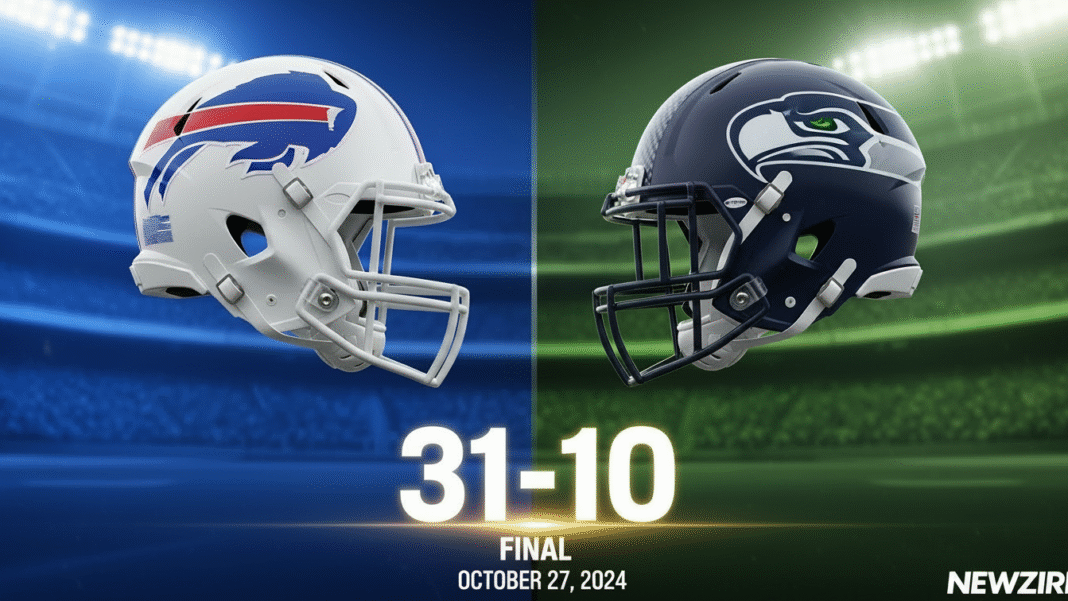
Buffalo crushed Seattle 31-10 at Lumen Field on October 27, 2024, dominating every statistical category. Josh Allen completed 24 of 34 passes for 283 yards and two touchdowns. James Cook rushed for 111 yards with two scores, while Khalil Shakir caught nine passes for 107 yards.
Seattle’s offense managed just 233 total yards. Geno Smith threw for 212 yards with one interception. Kenneth Walker III gained only 12 rushing yards as Buffalo controlled the trenches from kickoff to final whistle.
Table of Contents
Game Leaders: Bills vs Seahawks
| Category | Buffalo Bills | Seattle Seahawks |
|---|---|---|
| Passing | Josh Allen: 283 yards, 2 TD | Geno Smith: 212 yards, 0 TD |
| Rushing | James Cook: 111 yards, 2 TD | Geno Smith: 16 yards |
| Receiving | Khalil Shakir: 107 yards | Jaxon Smith-Njigba: 69 yards |
| Tackles | Taron Johnson: 8 total | Ernest Jones IV: 15 total |
| Sacks | Javon Solomon: 1.0 | Team: 1.0 |
| Interceptions | Austin Johnson: 1 | Josh Jobe: 1 |
Passing Statistics
Buffalo Bills Passing
| Player | Comp/Att | Yards | TD | INT | Sacks | Rating | Long |
|---|---|---|---|---|---|---|---|
| Josh Allen | 24/34 | 283 | 2 | 1 | 1-2 | 102.9 | 35 |
Allen completed 70.6 percent of his passes and averaged 8.3 yards per attempt. His touchdown passes went to Keon Coleman and Dalton Kincaid. Josh Jobe ended Allen’s franchise record streak of 300 consecutive passes without an interception.
Seattle Seahawks Passing
| Player | Comp/Att | Yards | TD | INT | Sacks | Rating | Long |
|---|---|---|---|---|---|---|---|
| Geno Smith | 21/29 | 212 | 0 | 1 | 1-11 | 78.5 | 20 |
Smith completed 72.4 percent of his throws but couldn’t find the end zone. Casey Toohill tipped a screen pass that Austin Johnson intercepted in the third quarter. Without DK Metcalf, ruled out with a knee injury per the Seahawks injury report, Seattle lacked any legitimate deep threat.
Rushing Attack Statistics
Buffalo Bills Ground Game
| Player | Carries | Yards | Average | TD | Long |
|---|---|---|---|---|---|
| James Cook | 17 | 111 | 6.5 | 2 | 18 |
| Ray Davis | 6 | 29 | 4.8 | 0 | 11 |
| Josh Allen | 7 | 25 | 3.6 | 0 | 9 |
| Team Total | 34 | 164 | 4.8 | 2 | 18 |
Cook posted his first 100-yard rushing performance of 2024. He became the first Bills running back with both 100 yards and multiple touchdowns in a game since Devin Singletary in 2021.
Seattle Seahawks Ground Game
| Player | Carries | Yards | Average | TD | Long |
|---|---|---|---|---|---|
| Kenneth Walker III | 9 | 12 | 1.3 | 0 | 5 |
| Geno Smith | 5 | 16 | 3.2 | 0 | 13 |
| Zach Charbonnet | 3 | 4 | 1.3 | 1 | 3 |
| Team Total | 17 | 32 | 1.9 | 1 | 13 |
Seattle gained one rushing yard in the entire first half, the second fewest Buffalo has allowed in a half this century. Walker got stuffed repeatedly at the line.
Receiving Statistics
Buffalo Bills Receivers
| Player | Receptions | Targets | Yards | Average | TD | Long |
|---|---|---|---|---|---|---|
| Khalil Shakir | 9 | 10 | 107 | 11.9 | 0 | 35 |
| Keon Coleman | 5 | 7 | 70 | 14.0 | 1 | 25 |
| Dawson Knox | 2 | 2 | 50 | 25.0 | 0 | 27 |
| Dalton Kincaid | 4 | 7 | 31 | 7.8 | 1 | 12 |
| James Cook | 3 | 3 | 22 | 7.3 | 0 | 12 |
| Amari Cooper | 1 | 2 | 3 | 3.0 | 0 | 3 |
Shakir recorded back-to-back 100-yard games. Coleman snagged a one-handed touchdown over Riq Woolen in the back corner of the end zone, extending fully and plucking the ball out of the air with his right hand. The rookie beat press coverage on the fade route and made the grab count. Six different receivers caught passes as Allen spread the ball around effectively.
Seattle Seahawks Receivers
| Player | Receptions | Targets | Yards | Average | TD | Long |
|---|---|---|---|---|---|---|
| Jaxon Smith-Njigba | 6 | 7 | 69 | 11.5 | 0 | 18 |
| AJ Barner | 2 | 2 | 34 | 17.0 | 0 | 20 |
| Kenneth Walker III | 4 | 5 | 33 | 8.3 | 0 | 17 |
| Noah Fant | 3 | 4 | 22 | 7.3 | 0 | 14 |
| Zach Charbonnet | 3 | 4 | 20 | 6.7 | 0 | 12 |
Smith-Njigba led Seattle’s receivers with Metcalf sidelined. Tyler Lockett, typically Seattle’s most reliable target, caught just one pass for nine yards in his worst performance of the season.
Defensive Statistics
Buffalo Bills Defense
| Player | Total Tackles | Solo | Sacks | TFL | Pass Def | QB Hits |
|---|---|---|---|---|---|---|
| Taron Johnson | 8 | 4 | 0 | 0 | 0 | 0 |
| Rasul Douglas | 6 | 5 | 0 | 1 | 1 | 0 |
| Baylon Spector | 5 | 3 | 0 | 0 | 0 | 0 |
| Greg Rousseau | 4 | 3 | 0 | 2 | 2 | 1 |
| Austin Johnson | 1 | 0 | 0 | 0 | 1 | 0 |
Austin Johnson grabbed his first career interception after playing 52 games over five seasons. The defensive tackle showed good hands on the deflected pass. Rousseau batted down two passes on Seattle’s opening drive, setting the defensive tone immediately. Buffalo held Seattle to 233 total yards according to Pro Football Reference.
Seattle Seahawks Defense
| Player | Total Tackles | Solo | Sacks | TFL | Pass Def | QB Hits |
|---|---|---|---|---|---|---|
| Ernest Jones IV | 15 | 7 | 0 | 0 | 0 | 0 |
| Tyrel Dodson | 7 | 5 | 0 | 0 | 0 | 0 |
| Josh Jobe | 7 | 5 | 0 | 0 | 1 | 0 |
| Coby Bryant | 6 | 5 | 0 | 0 | 1 | 0 |
Jones led all defenders with 15 tackles in his second game since being traded from Tennessee. Jobe picked off Allen in the second quarter, returning it to the seven yard line. But Seattle couldn’t capitalize, turning it over on downs at the one.
Special Teams and Team Statistics
| Category | Buffalo Bills | Seattle Seahawks |
|---|---|---|
| Field Goals | Tyler Bass: 1/1 (27 yards) | Jason Myers: 1/1 (38 yards) |
| Extra Points | Tyler Bass: 4/4 | Jason Myers: 1/1 |
| Punting Average | Sam Martin: 49.0 (3 punts) | Michael Dickson: 61.3 (4 punts) |
| Punt Return Avg | Brandon Codrington: 11.7 | Dee Williams: 0.0 |
| Kick Return Avg | Ray Davis: 20.5 | Laviska Shenault: 25.0 |
Overall Team Stats
| Category | Buffalo Bills | Seattle Seahawks |
|---|---|---|
| Total Yards | 445 | 233 |
| First Downs | 29 | 17 |
| Third Down Conv. | 8/15 (53.3%) | 1/7 (14.3%) |
| Fourth Down Conv. | 1/1 (100%) | 0/1 (0%) |
| Time of Possession | 38:03 | 21:57 |
| Penalties | 13 for 85 yards | 11 for 82 yards |
| Turnovers | 1 | 2 |
| Red Zone Efficiency | 4/6 (66.7%) | 1/3 (33.3%) |
How the Game Unfolded
Buffalo’s opening drive set the tone. Fourteen plays. Ninety yards. Nine minutes and seven seconds. Allen capped it with a two-yard touchdown pass to Coleman in the back corner of the end zone.
Seattle? Three and out on both of their first two possessions.
The second quarter turned on Seattle’s red zone failures. Buffalo’s defense made crucial goal line stands twice in the span of eight minutes. First, Connor Williams snapped the ball over Smith’s head from the three yard line. The ball sailed past Smith and rolled back 19 yards before Kenneth Walker recovered it at the 22. Seattle settled for a 38-yard field goal.
Their next chance came after Jobe intercepted Allen at the Buffalo 40 and returned it to the seven. First and goal from the seven. Seattle ran twice and got to the one yard line. Fourth and goal from the one.
Williams took the snap and immediately stepped on Smith’s foot. Smith stumbled backward, helpless as Buffalo’s defense swarmed him for a six-yard loss. The momentum shifted completely.
Buffalo answered with a 93-yard touchdown drive before halftime. The drive took 4 minutes and 26 seconds and covered 12 plays. Allen found Kincaid for a 12-yard touchdown with 18 seconds left in the half. Buffalo became the first team since 2022 to have two 90-yard touchdown drives in one half, per ESPN.
The third quarter brought more Buffalo dominance. After opening with a 69-yard field goal drive, the Bills got the ball back when Austin Johnson intercepted Smith on a tipped screen pass. Seven plays later, Cook scored from two yards out for a 24-3 lead. Cook added another touchdown in the fourth quarter on a seven-yard run, finishing a 73-yard drive that ate up the clock.
Seattle’s only touchdown? A one-yard Charbonnet plunge with 8 minutes left and the game already decided.
Third Down Execution Won This Game
Buffalo converted eight of 15 third downs. Seattle converted one of seven.
The Bills averaged five yards to go on third down. Seattle averaged 11. That difference determined everything. When you’re facing third and manageable, you have options. Third and long? You’re guessing, and defenses know it.
Allen converted multiple third downs with his legs too, rushing seven times for 25 yards when Seattle’s coverage held up.
Seattle’s offense stalled repeatedly. Five of their seven third down failures came on third and eight or longer. Smith had no chance on most of them, facing pressure from Buffalo’s front four and tight coverage downfield.
Buffalo’s Offensive Balance
Perfect balance from the Bills. Thirty-four rushes. Thirty-four passes.
That’s how you control a game on the road.
Cook broke through with his best performance of the season. He broke four tackles on 17 carries with patience and vision that make him dangerous. His two touchdowns gave him five rushing scores in three games, averaging 6.5 yards per carry over that stretch.
Cook’s 111 rushing yards combined with Shakir’s 107 receiving yards marked the first time Buffalo had both a 100-yard rusher and 100-yard receiver in the same game since Week 14, 2018 against the Jets. That kind of balance forces defenses into impossible coverage decisions.
Shakir gained 89 yards after the catch. The slot receiver made defenders miss with sharp cuts and acceleration. He caught nine of 10 targets without dropping a pass. His 35-yard reception in the third quarter came on a shallow cross where he made two defenders miss before getting pushed out of bounds.
Coleman’s breakout continued beyond the highlight touchdown. He added four more catches including a 25-yard gain on third and four, showing he can beat press coverage, make contested catches, and move the chains. His blocking downfield also opened running lanes for Cook.
Allen spread passes to six different receivers. He rushed seven times for 25 yards, picking up first downs when Seattle’s coverage held. Despite throwing one interception, his 102.9 passer rating reflected efficient execution throughout.
Seattle’s Offensive Line Problems Defined the Loss
Seattle’s offensive line was dominated in the trenches. Near the goal line in the second quarter, Greg Rousseau and Ed Oliver pushed Kenneth Walker backward for a one-yard loss on first down. The next play, from the three yard line, brought the snap over Smith’s head. Williams made two critical mistakes that killed scoring opportunities when Seattle desperately needed points.
With just 12 yards on nine carries, Walker posted his worst performance of the season against a Buffalo front seven that sealed the edges and forced him inside where the tackles were waiting. Walker typically beats defenses with speed to the perimeter. Buffalo took that away completely.
Smith averaged just 7.3 yards per attempt despite completing over 72 percent of his passes. Buffalo’s defense could focus on underneath routes and load the box against the run. Smith had nowhere to go with the ball.
The Seahawks rank last in the NFL in rushing at 75.7 yards per game. This performance dropped that average even further. Smith took a sack for an 11-yard loss when protection broke down in the fourth quarter. He scrambled five times for 16 yards trying to extend plays, but Buffalo’s pass rush stayed disciplined in their rush lanes.
Seattle went three and out five times. Their longest drive lasted 7 minutes and 4 seconds in the first half when they drove to the Buffalo two before the botched snap. Otherwise, the Seahawks couldn’t sustain anything.
Red Zone Efficiency Decided the Outcome
Buffalo scored touchdowns on four of six red zone trips, a 67 percent touchdown rate. Both of Cook’s scores came inside the 10. Allen’s two touchdown passes came inside the 20, with perfect placement on both throws.
Seattle? One touchdown on three red zone chances.
Buffalo’s defense made the crucial stops on both second quarter goal line stands. Greg Rousseau pushed Walker back on first down from the two, then chased down Smith on the fourth down attempt from the one. Those two series shifted the entire momentum of the game.
When you get inside the 10 twice and come away with three points total, you’re not winning the game. Seattle had their chances. They just couldn’t finish.
Time of Possession and Defensive Dominance
Buffalo held possession for 38 minutes and 3 seconds, their highest mark of the season. The Bills ran 69 plays. Seattle ran 47.
That’s dominance.
The opening drive ate up over nine minutes. Buffalo’s 93-yard touchdown drive before halftime took 4 minutes and 26 seconds. In the second half, the Bills ran 6 minutes and 29 seconds off the clock on their field goal drive. Cook’s first touchdown drive consumed another 4 minutes and 2 seconds.
Seattle couldn’t stay on the field. The Seahawks went three and out on their first two possessions, immediately putting their defense in a bad spot. Their average drive lasted just 2 minutes and 26 seconds. When your offense can’t control the clock, your defense gets worn down. That’s exactly what happened.
Rousseau harassed Smith throughout the game. The defensive end batted down two passes on the opening drive and recorded two tackles for loss. He was in the backfield constantly, disrupting Seattle’s timing. Buffalo’s defensive game plan focused on taking away the edges where Walker thrives, forcing Seattle into predictable inside runs that the defensive tackles could blow up.
Ernest Jones led all players with 15 tackles in his second game since being traded from Tennessee. The linebacker was active sideline to sideline in both run support and pass coverage.
Jobe’s interception was the first of his career, ending Allen’s 300-pass streak without a pick. The cornerback jumped the route perfectly, showing why Seattle elevated him from the practice squad.
What This Game Means for the AFC East and NFC Battles
Buffalo improved to 6-2, matching their best start through eight games in the last 30 seasons (also achieved in 2019, 2020, and 2022), while Allen moved to 22-6 in his career against NFC opponents. The Bills extended their lead in the AFC East standings with the victory.
The Bills have scored 30 or more points in four games this season. Their defense has allowed 20 or fewer points in six of eight contests. That combination makes them dangerous. When your offense can score consistently and your defense keeps teams under 20, you’re going to win most games.
Buffalo improved to 7-8 all time against Seattle in regular season play. They’ve won four of the last five meetings between these franchises.
Seattle fell to 4-4, losing for the fourth time in five games after starting 3-0. The Seahawks dropped to 2-3 at home, where they’re supposed to have an advantage with the 12th man crowd noise. Their rushing attack continues to rank dead last in the NFL. Without a consistent ground game, Seattle asks too much of Smith’s arm. That becomes harder when defenses can pin their ears back and rush the passer on obvious passing downs.
The playoff race in the NFC West remains tight, but Seattle needs to fix their offensive line and running game immediately. The loss exposed fundamental problems that quality defenses will continue to exploit.
For comprehensive NFL coverage and updated standings throughout the 2024 season, visit Newzire.
Buffalo Proves They’re Legitimate AFC Contenders
This wasn’t just a road win. This was a statement about Buffalo’s playoff credentials.
Buffalo dominated both lines of scrimmage while controlling possession by 16 minutes and scoring touchdowns on 67 percent of red zone trips. They held Seattle to 1.9 yards per carry and forced two turnovers. Scoring on two-thirds of red zone chances while holding opponents under 2 yards per carry is the formula that wins playoff games.
Allen’s two touchdown passes and Cook’s two touchdown runs provided the offensive firepower. The defense stifled Seattle’s running game and made Smith one-dimensional. Shakir and Coleman stepped up as reliable targets alongside the veteran presence of Amari Cooper, who’s still getting integrated into the offense.
Buffalo’s 34 rushes and 34 passes – perfect balance – kept Seattle’s defense from loading the box or dropping eight in coverage. When they needed to run clock, Cook and the offensive line delivered. When they needed a big play, Allen found Shakir or Coleman downfield. That versatility creates matchup problems.
The Bills proved they can win decisively on the road in hostile environments. They dominated from the opening kickoff, controlling the game without relying solely on Allen’s arm. Cook’s breakout performance gives them a rushing threat that complements their passing attack perfectly. With Von Miller returning from suspension in Week 9, their pass rush gets even more dangerous.
Seattle’s problems run deeper than one bad game. Their offensive line struggles continue, and they lack explosive plays without their top receiver. Williams’ two critical mistakes exemplified their issues at the line of scrimmage. Until they establish a running game and protect Smith better, they’ll struggle against physical defenses like Buffalo’s.
Buffalo’s 6-2 record, paired with their dominance in time of possession and red zone efficiency, establishes them as a legitimate threat in the AFC playoff race. Seattle’s offensive line problems and inability to run the ball leave them facing an uphill battle in the competitive NFC West.