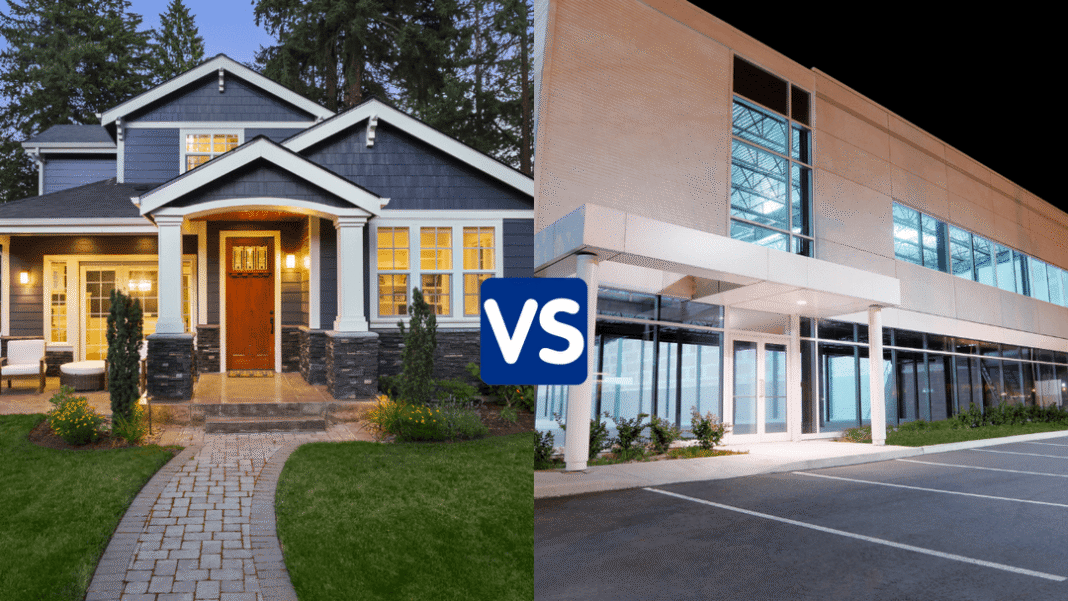
There’s a moment most homeowners have experienced: you drive past a well-maintained hotel entrance, a corporate campus, or even a well-funded municipal park, and you notice that the landscaping looks almost unnervingly perfect. The beds are crisp. The transitions between surfaces are razor-sharp. Nothing is creeping where it shouldn’t be, nothing is fading, nothing looks like it was installed last spring and already starting to fail. Then you pull into your own driveway and wonder what’s different.
It isn’t just money, though that plays a role. And it isn’t professional crews with commercial mowers, though that’s part of it too. A significant piece of the answer lies in something most homeowners never think about: the specification of materials used before a single plant goes in the ground.
Commercial landscaping starts with a different set of standards.
When a hotel, office park, or municipal authority commissions landscaping, the design brief doesn’t just specify plants, hardscaping, and irrigation. It specifies the load class of pavers, the gauge of edging, the corrosion resistance rating of metal components, and the expected service life of every installed element. Materials are selected not for how they look on a showroom shelf but for how they perform under daily foot traffic, seasonal freeze-thaw cycles, regular maintenance equipment, and years of exposure to irrigation runoff and soil chemistry.
Consumer-grade products, by contrast, are typically spec’d for light residential use — occasional foot traffic, moderate weather, and the assumption that they’ll be replaced within a few years. The performance gap between these two categories is substantial, but it rarely shows up on a product label. It shows up eighteen months into an installation, when the plastic edging has warped, the borders have migrated, and the beds that looked clean in April look ragged by August.
The edge is where everything becomes visible.
One of the clearest visual differences between a polished commercial landscape and an average residential one is the crispness of transitions — specifically, the lines where lawn meets bed, where mulch meets pathway, and where one ground surface gives way to another. On a well-specified commercial property, these lines are defined by edging material that holds its position, its geometry, and its finish regardless of what the soil does around it.
This is not an accident. It’s the direct result of using materials that were engineered to resist the pressures that landscaped transitions face: lateral soil movement, root intrusion, freeze-heave, and the mechanical stress of string trimmers and edging tools passing close by on a maintenance schedule. Commercial grade landscape edging — typically made from stainless steel, heavy-gauge galvanized steel, or aircraft-grade aluminum — maintains dimensional stability and surface integrity under exactly these conditions. The line it creates on day one is functionally the same line it creates three years later.
What “grade” actually means in practice.
The word “commercial” attached to a product category isn’t just marketing language — it corresponds to measurable differences in material thickness, alloy composition, connection system engineering, and testing standards. A commercial-spec stainless steel edging strip, for instance, uses 304-grade stainless steel, which provides genuine corrosion and chemical resistance rather than the superficial rust-resistance of a simple coating. A commercial aluminum edging profile is extruded to a consistent gauge that maintains its shape when backfilled under pressure, rather than flexing and deforming the way thinner profiles do.
Connection systems matter just as much as the material itself. Consumer edging often relies on friction fits or plastic connectors that fail when the ground moves. Commercial-grade systems use interlocking slide-and-groove joints that maintain a seamless line even as individual sections expand and contract with temperature changes.
The replication question.
Here’s the practical truth: nothing prevents homeowners from specifying commercial-grade materials for their own landscapes. The products exist, they’re available through the same supply channels that professional landscapers use, and the price premium — while real — is modest relative to the cost of replacing consumer-grade materials on a two- to three-year cycle.
The barriers are mostly informational. Most homeowners shop for edging at a big-box garden center and choose based on what’s visible on the shelf. Landscaping contractors sometimes specify heavier-duty materials for their own sanity — they’d rather install something once than return to reinstall it after the first hard winter — but they don’t always offer clients a clear breakdown of what they’re actually getting.
The shift in mindset required is simple but not obvious: stop thinking about landscape materials as seasonal consumables and start thinking about them as permanent infrastructure. The concrete in your driveway isn’t replaced every three years. Your gutters aren’t budgeted as annual purchases. The edging that defines every bed and transition in your yard shouldn’t be either.
The commercial properties that look effortlessly polished aren’t maintained by magic. They were specified correctly at the beginning — and then left alone to do their job.