Caleb Lawrence McGillvary, a 37-year-old Canadian, files lawsuits from New Jersey State Prison against YouTubers and Netflix. Courts dismiss them. He will not be eligible for parole until October 2061, when he reaches 73 years old.
That is the same age Joseph Galfy Jr. was when McGillvary beat him to death in May 2013.
Twelve years ago, McGillvary was the internet’s unlikely hero. The homeless hitchhiker from Edmonton, Alberta who stopped a violent attacker in California with a hatchet. His animated interview about the incident went viral, racking up 8.6 million YouTube views. He appeared on Jimmy Kimmel Live. Media companies pursued him. He became famous overnight.
Three months after that interview aired on KMPH Fox, police arrested him for first-degree murder. The victim was Galfy, a 73-year-old New Jersey attorney McGillvary had met in Manhattan’s Times Square. Galfy offered him a place to stay. Two days later, police found Galfy’s body in his bedroom. Three skull fractures. Four broken ribs. Facial bones crushed.
McGillvary claimed self-defence. Said Galfy drugged and raped him. A Union County jury heard four weeks of testimony in 2019 and convicted him of murder.
Table of Contents
The Fresno Attack
At approximately 2:30pm on 1 February 2013, Jett Simmons McBride drove his Oldsmobile into Rayshawn Neely at the intersection of Marks and McKinley in Fresno, California. Neely, a Pacific Gas & Electric lineman, was working on power lines when McBride’s car pinned him against a utility truck.
McBride had picked up McGillvary hitchhiking near Bakersfield earlier that day. During the drive, McBride told his passenger he was Jesus Christ. He confessed to raping a 14-year-old girl in the Virgin Islands.
Ken Simon, another lineman, tried pulling Neely free when McBride’s car struck him as well. McBride exited his vehicle and began pulling at Neely, who remained trapped and screaming. Witnesses later testified McBride shouted racial slurs and said he was taking Black people to heaven.
Tanya Baker, a bystander, ran to help. McBride grabbed her.
McGillvary retrieved a hatchet from his backpack. He struck McBride three times in the head with the blunt end. Other PG&E workers wrestled McBride to the ground and restrained him until police arrived.
Officers questioned McGillvary at the scene and released him. They determined he used justifiable force to protect others. Neely was transported to hospital for emergency surgery on his shattered right leg.
The Interview
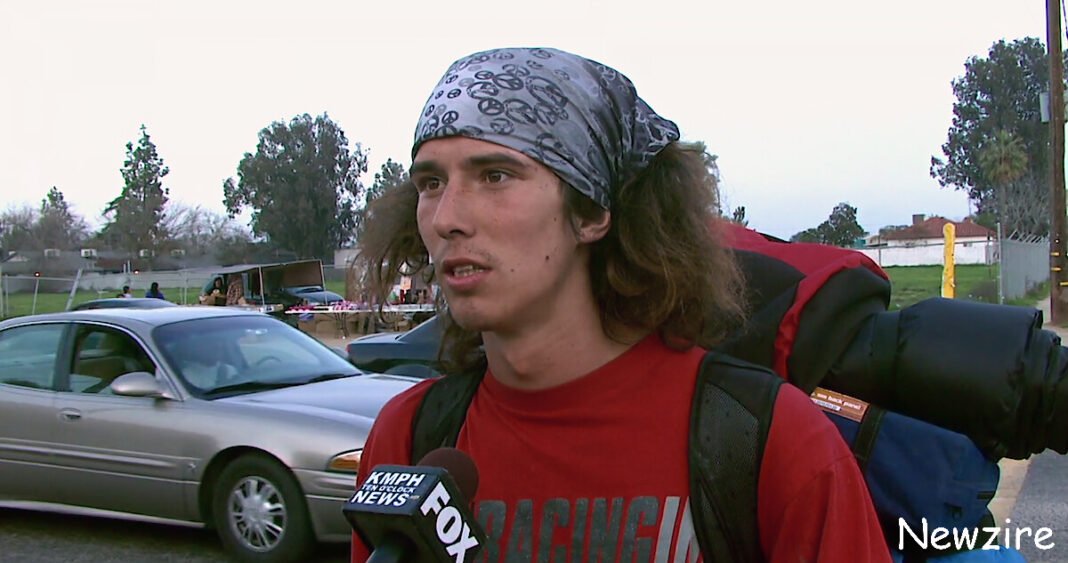
KMPH reporter Jessob Reisbeck found McGillvary at the crash scene. McGillvary, wearing a bandana around his long hair, described what happened.
“A guy that big can snap a woman’s neck like a pencil stick,” McGillvary told Reisbeck. “So I ran up behind him with a hatchet.” He demonstrated the overhead swings. “Smash, smash, suh-MASH!”
The interview aired on the local Fox affiliate. Reisbeck uploaded the footage to YouTube on 2 February 2013. Within 48 hours, it reached millions of views. The Gregory Brothers created an auto-tune remix. By the end of the first week, the video had accumulated 8.6 million views.
McGillvary became an internet sensation.
McBride’s Trial
Jett McBride went to trial in Fresno County in early 2014 for the attack on the PG&E workers. He pleaded not guilty by reason of insanity. Defence attorney Scott Baly argued McBride believed he was Jesus Christ when he drove into those men.
The jury found McBride not guilty of attempted murder by reason of insanity but convicted him of assault with a deadly weapon. A judge sentenced him to nine years in a mental health facility.
Rayshawn Neely spent months recovering. He used a wheelchair initially, then crutches. He eventually regained the ability to walk. IBEW Local 1245 awarded life-saving honours to the PG&E crew members who rescued Neely and subdued McBride.
Fame and Exploitation
The viral video brought immediate media attention. McGillvary appeared on Jimmy Kimmel Live on 11 February 2013. Before the show, Kimmel handed McGillvary an envelope containing $500. McGillvary gave it to a security guard. On air, Kimmel introduced him as “an unlikely hero.”
Brad Mulcahy, who worked as a researcher for Jimmy Kimmel Live, later recalled finding McGillvary heavily intoxicated before tapings. McGillvary urinated in public on at least one occasion before going on camera.
Lisa Samsky, a reality television brand manager who worked on Keeping Up With the Kardashians, approached McGillvary about a show. “We weren’t exactly sure what the show was gonna be,” Samsky admitted in the 2023 Netflix documentary about the case. “But I think what people saw at my company was Kai could be a gateway to a world we never saw – homeless people living happily on the streets.”
Justin Bieber’s representatives contacted McGillvary about potential collaborations. Other producers offered deals. McGillvary signed one contract in hieroglyphs.
His Facebook inbox accumulated over 10,000 messages from people across America. Fans invited him to stay with them. McGillvary accepted many invitations. He travelled state to state between February and May 2013, meeting people who had seen the viral video.
On 10 May 2013, McGillvary posted on Facebook: “ive met some of the greatest people in my life in these last three months.”
Joseph Galfy
Joseph Galfy Jr. was born on 15 October 1939 in Newark, New Jersey. He joined the United States Army after university and served during the Vietnam War era, achieving the rank of major. After his service ended in 1970, he attended Seton Hall law school.
By 2013, Galfy had practised law for over 40 years. He was a partner at Kochanski, Baron and Galfy in Rahway, handling land-use cases and domestic violence work. He served as attorney for Green Brook’s planning board.
At 73, Galfy stood 5-foot-5 and weighed 230 pounds. He had a heart condition requiring a stent in his chest. Friends and colleagues described him as gentle and mild-mannered. One associate later testified at trial that he loved Galfy but would not trust him to win a bar fight.
Galfy played drums in a wedding band for 25 years. He supported the New York Giants and enjoyed travelling. His sister Marcella predeceased him. His brother James and James’s wife Diane survived him.
Galfy lived alone in a house on Starlight Drive in Clark, New Jersey.
Meeting in Times Square
On 11 May 2013, Galfy drove to Manhattan. He met McGillvary in Times Square near the bus depot. They had beers together at a restaurant. Galfy offered the viral internet celebrity a ride to New Jersey and a place to stay. McGillvary accepted.
Galfy drove McGillvary to his house in Clark. They had dinner. According to McGillvary’s testimony at trial, Galfy insisted on pouring McGillvary’s beer into a glass rather than allowing him to drink from the bottle. They watched television in the living room. McGillvary drank approximately five beers.
McGillvary spent the night in the guest bedroom.
The Train Station
On the morning of 12 May 2013, Galfy drove McGillvary to Rahway railway station. Surveillance cameras recorded them arriving around 10am. The footage shows Galfy approaching a ticket vending machine, purchasing a ticket, and handing it to McGillvary. The two men embraced. McGillvary boarded a train to Asbury Park to meet someone he had connected with on Facebook.
The person did not appear. McGillvary contacted Galfy from Asbury Park. He asked if he could return and stay another night. Galfy agreed and told McGillvary he would collect him from the station.
That evening, Galfy picked up McGillvary and drove him back to Clark. They stopped for Italian food near Galfy’s house. At home, they drank more beer while watching television.
McGillvary later testified he remembered sitting in the living room “feeling warm and fuzzy.” He heard the Jeopardy theme song. That was the last thing he recalled before waking up on the floor of Galfy’s bedroom.
The Night of 12-13 May
On 14 May 2013, before anyone knew Joseph Galfy was dead, McGillvary posted on Facebook: “what would you do if you woke up with a groggy head, metallic taste in your mouth, in a strangers house… walked to the mirror and seen come dripping from the side of your face from your mouth, and started wretching, realizing that someone had drugged, raped and blown their fuckin load in you?”
The post received dozens of comments. One follower suggested hitting the attacker with a hatchet.
McGillvary replied: “I like your idea.”
Prosecutors argued at trial that these Facebook posts were self-serving. McGillvary was constructing an alibi before the body was discovered, they said.
McGillvary testified that Galfy drugged and sexually assaulted him, and that he fought back in self-defence. Prosecutors argued the sexual encounter was consensual and the killing was premeditated. Medical evidence later contradicted McGillvary’s self-defence claims.
Discovery
On 13 May 2013, Galfy failed to appear for a scheduled court hearing. His secretary attempted to reach him by telephone multiple times. When he did not answer, she contacted Bob Ellenport, Galfy’s neighbour, and asked him to check on Galfy.
Ellenport walked to the house on Starlight Drive. The Sunday newspaper remained on the porch. No one answered the door. Ellenport called police.
Officers forced entry around midday. They found Galfy in his bedroom, lying face-down beside the bed. He wore only socks and underwear. Blood covered the floor, walls and bed.
Dr Junaid Shaikh, the Union County medical examiner, conducted the autopsy. He documented three skull fractures, four broken ribs, and massive blunt-force trauma to Galfy’s face, head, neck, chest and arms. Galfy’s facial bones were crushed. The injuries were catastrophic.
Detectives found a piece of paper near a laptop in the family room with McGillvary’s telephone number written on it. They found the train ticket receipt dated 12 May in the master bedroom. Both pieces of evidence led investigators to the railway station surveillance footage.
Investigation and Arrest
Union County Prosecutor Theodore Romankow issued a warrant for McGillvary’s arrest on 16 May 2013. McGillvary had changed his appearance by cutting his distinctive long hair short.
On the afternoon of 16 May, McGillvary entered a Starbucks in downtown Philadelphia. The barista recognized him despite the new haircut. She telephoned 911 after he left. McGillvary went to the Greyhound bus terminal several blocks away.
Police located him at the terminal within minutes. They arrested him without incident. He had been attempting to leave the city.
Romankow told reporters: “I believe that everyone is a little safer with this person off the streets.”
Six Years in Custody
McGillvary remained in Union County Jail from May 2013 until his trial began in April 2019. He spent much of that time in solitary confinement, isolated 23 hours per day.
In July 2013, guards discovered McGillvary with self-inflicted wounds. He was hospitalized and then returned to the jail.
Supporters who had celebrated McGillvary as a hero after the Fresno incident attempted to help. They raised money for his legal defence through crowdfunding platforms. They started Change.org petitions calling for his release. A legal fund collected donations from people who believed his self-defence claims.
The Trial
The trial began on 1 April 2019 in Union County Superior Court. Judge Robert Kirsch presided. Assistant Prosecutors Scott Peterson and Jillian Reyes handled the case for the state. McGillvary pleaded not guilty and claimed self-defence.
McGillvary took the witness stand. He testified that Galfy insisted on pouring his beer into glasses and that the beer tasted strange. He remembered feeling warm and fuzzy, hearing the Jeopardy theme song on television, then waking up on Galfy’s bedroom floor with the older man on top of him.
“What would you do if you woke up with a groggy head, metallic taste in your mouth, in a stranger’s house?” McGillvary asked from the witness stand.
Prosecutors presented evidence that McGillvary had posted about the alleged assault on Facebook before anyone knew Galfy was dead. They argued he was building an alibi. They noted he had cut his hair to change his appearance and fled across state lines to Philadelphia.
The sexual encounter was consensual, prosecutors argued. McGillvary had met Galfy seeking a place to stay. They exchanged telephone numbers. The surveillance footage showed them embracing at the train station. The murder was premeditated.
Dr Shaikh testified for the prosecution. He described Galfy’s injuries in detail. Three skull fractures. Four broken ribs. Extensive trauma. He noted that Galfy stood 5-foot-5, weighed 230 pounds, and had a heart condition requiring a chest stent. A frail 73-year-old man who posed no physical threat to someone younger and stronger.
Judge Kirsch later noted in court documents that Galfy’s injuries were “far more than just an effort to thwart a sexual advance.” The medical evidence contradicted McGillvary’s self-defence claims.
McGillvary became combative during cross-examination. He argued with prosecutors and raised his voice. During his own defence lawyer’s closing arguments, McGillvary had an outburst severe enough that Judge Kirsch threatened to remove him from the courtroom.
Court transcripts show Kirsch warning McGillvary: “I know they have security cameras in here and they’re being viewed as we speak.” The judge later described McGillvary as someone who had “been hostile, aggressive, noncompliant, had repeatedly ignored serial admonitions from the Court over and over again.”
In sentencing documents, Kirsch called McGillvary “a powder keg of explosive rage.” He described him as “crafty, cunning, disingenuous and manipulative” and noted “his conduct had been serially contemptuous.”
The jury deliberated for several hours across two days.
On 24 April 2019, they returned a verdict of guilty on first-degree murder.
Sentencing
Judge Kirsch sentenced McGillvary on 30 May 2019 to 57 years in New Jersey State Prison. He must serve 85 percent of the sentence before becoming eligible for parole. That requires 48 years minimum.
Accounting for time served before trial, McGillvary will be 73 years old when he becomes eligible for parole in October 2061.
“When you become eligible for parole, you will still be younger than Mr. Galfy was when you murdered him,” Kirsch told McGillvary from the bench.
McGillvary responded by calling the trial “a sham” that “railroaded an innocent man.”
Acting Union County Prosecutor Michael Monahan issued a statement: “This was a brutal, vicious, senseless crime, and we are pleased that the interests of justice have been served. We sincerely thank the jury for their service and hope that today’s verdict brings some measure of solace to Mr. Galfy’s family, friends, and loved ones.”
The Appeal
McGillvary filed an appeal in 2021. He alleged 15 instances of prosecutorial misconduct, judicial errors and ineffective assistance of counsel. He claimed evidence was suppressed, the trial was unfair, and the verdict lacked evidentiary support.
New Jersey Appellate Court Judges Carmen Alvarez and Richard Geiger reviewed each claim. In August 2021, they rejected all 15 points. The conviction was upheld.
McGillvary remains at New Jersey State Prison in Trenton as inmate number 210329.
Netflix and Legal Actions
On 10 January 2023, Netflix released The Hatchet Wielding Hitchhiker, a documentary examining McGillvary’s case. The film featured interviews with Jessob Reisbeck, the KMPH reporter who made McGillvary famous, along with Jimmy Kimmel’s staff, McGillvary’s family and law enforcement officials.
McGillvary responded from prison. He claimed Netflix exploited him without compensation. “Netflix is making a movie about my life story before I was arrested, But they refuse to pay me anything for it,” he wrote.
McGillvary has since filed multiple lawsuits from his prison cell. Courts have dismissed each case.
On 30 September 2025, US District Judge C. Ashley Royal dismissed McGillvary’s defamation case against The Behavior Panel, a YouTube channel operated by body language analysts Greg Hartley, Chase Hughes and Scott Rouse. The analysts had examined McGillvary’s original KMPH interview and made observations about his personality and mental state.
McGillvary objected to 28 statements in their video. He claimed they defamed him by suggesting he had personality disorders, by analysing his body language to determine whether he was a sociopath or psychopath, and by calling him “a bit of a mongrel from the backstreets.”
Judge Royal ruled the statements were opinions based on subjective assessments of publicly available footage. They were not defamatory and were protected by the First Amendment.
In December 2025, Judge Jennifer Hall in Delaware dismissed similar claims against Todd Grande, a licensed mental health counsellor who operates a YouTube channel analysing criminal cases. Hall determined that Grande’s statements were opinions and characterizations, not assertions of fact.
McGillvary has also sued Netflix, various California media companies involved in the documentary, and comedian Theo Von. Courts have rejected these cases. Judges have noted that McGillvary voluntarily made himself a public figure and that the matters discussed are of legitimate public concern.
McGillvary claims he trademarked “Smash, smash, suh-MASH!” and “Kai the Hatchet Wielding Hitchhiker.” Courts have found no merit in his trademark claims.
The Legacy
The KMPH interview recorded by Jessob Reisbeck on 1 February 2013 remains on YouTube with 8.6 million views. People continue to watch it, share it and comment on it.
McGillvary’s cousin told Netflix filmmakers: “I honestly believe Caleb has mental issues, because he seems well but when it comes to a certain situation of pressure, you either become a diamond or you get crushed. And in this case, Caleb gets crushed.”
Joseph Galfy’s funeral was held on 17 May 2013 at a chapel in Warren, New Jersey. He was buried in East Hanover. His obituary in The Star-Ledger said he was a devoted brother, uncle and friend who loved travelling, the New York Giants and music. It noted he had played drums in a wedding band for 25 years.
Galfy’s death received news coverage because of who killed him, not because of who he was.
Caleb McGillvary saved a woman from a violent attack in Fresno. Police cleared him and determined he used justifiable force. Three months later, he beat to death a man who offered him a place to stay. The first act made him a hero. The second made him a convicted murderer serving 57 years.