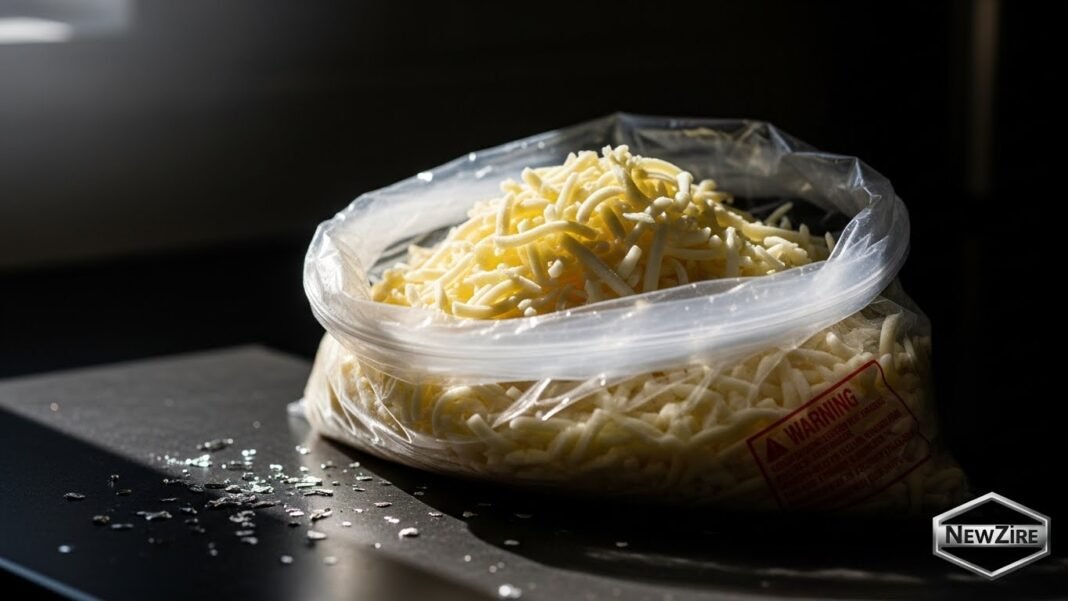
Two Happy Farms products sold at Aldi stores across 31 US states contain metal fragments from contaminated raw materials. The sell-by dates extend into late February 2026, so affected cheese may still be in refrigerators and freezers.
Great Lakes Cheese Co. pulled the products October 3, 2025 after a supplier flagged the issue. But the Ohio manufacturer issued no public announcement. Most consumers learned about the recall two months later when the FDA published its enforcement report in December and assigned a Class II classification, indicating potential for temporary or reversible injury.
No illnesses have been reported as of January 10, 2026.
Table of Contents
The Affected Products
Happy Farms Mozzarella Shredded Cheese comes in 16-ounce bags (UPC 4061463330864) and 32-ounce bags (UPC 4061463369413). Five production runs are affected:
- Batch 1500560016, sells by February 8, 2026
- Batch 1500562694, sells by February 14, 2026
- Batch 0008915062, sells by February 18, 2026
- Batch 0008921597, sells by February 21, 2026
- Batch 0008914480, sells by February 13, 2026
Happy Farms Italian Style Shredded Cheese Blend in 12-ounce bags (UPC 4061463330949) has two affected runs:
- Batch 0008922982, sells by February 22, 2026
- Batch 0008926344, sells by February 23, 2026
All three identifiers on your package must match for the cheese to be affected. Only specific October production runs contained the contaminated material.
How Shoppers Found Out
When the recall surfaced online in early December, Aldi customers took to Reddit with concern and confusion. “I just ate an entire bag of the mozz. Is this the end?” one user wrote in the r/aldi community. Another reported making lasagna with it days earlier. A third noted texture problems with Happy Farms cheese recently.
The thread gained over 150 upvotes, with dozens of commenters checking their fridges. Several pointed out that Aldi’s official corporate recall page still doesn’t list the Happy Farms products. “Why the fuck does metal fragments qualify for a ‘voluntary’ recall?” one user asked.
The issue stems from a supplier’s raw mozzarella. Great Lakes Cheese told ABC News it isolated the affected material immediately in October and instructed retailers to clear shelves. Metal typically enters the production line when processing equipment degrades. Shredding blades wear down, conveyor components break loose, packaging machinery parts fracture under constant use.
Because Great Lakes supplies private-label brands for multiple retailers, the same raw material affected products at Walmart (Great Value), Target (Good & Gather), Publix, and Sprouts. Total volume reached 263,575 cases.
Darin Detwiler, a food safety expert at Northeastern University, explained to journalists how one manufacturer’s problem spreads. “A single cheese processor may produce dozens of private-label cheeses. If one production line has an issue, every brand that used that line during that window is included.”
The Health Risk
The FDA states metal pieces between 7mm and 25mm pose unacceptable danger in food. Smaller fragments still cause harm. A sharp piece could lacerate the mouth or throat, chip teeth, or perforate the intestine. Children and elderly people face heightened choking risk.
Anyone experiencing abdominal pain, difficulty swallowing, or unexplained mouth injuries after eating the cheese should see a doctor. Throat swelling or breathing trouble requires emergency care.
Where It Was Sold
Aldi stores in Alabama, Arizona, Arkansas, California, Colorado, Florida, Georgia, Idaho, Illinois, Indiana, Kansas, Kentucky, Louisiana, Minnesota, Mississippi, Missouri, Nebraska, Nevada, New Mexico, New York, North Carolina, Oklahoma, Oregon, Pennsylvania, South Carolina, Tennessee, Texas, Utah, Virginia, Washington, Wisconsin, and Puerto Rico stocked the products between October and December 2025.
Shoppers who freeze shredded cheese for later use should verify their freezer contents, particularly purchases from that window.
The Two-Month Silence
Great Lakes Cheese initiated the recall October 3 but issued no press release. CBS News confirmed the company made no public statement. Information reached most consumers when the FDA published its enforcement report December 1, two months later.
Food safety alerts typically work through manufacturer notifications to retailers, who remove products and contact customers. When companies choose silence, critical information doesn’t reach the people who need it. Products manufactured in autumn 2025 with February 2026 expiry dates could remain in homes where shoppers bought them before the news broke and stored them frozen.
The FDA classifies recalls by health risk. Class I means serious harm or death is probable. Class III means minimal risk. This received Class II, indicating temporary or reversible consequences are possible but serious injury is unlikely.
Great Lakes Cheese maintains all affected products left stores in October. “We instructed retailers to remove the products from store shelves after the announcement in October,” the company said. “When we were confident all recalled products had been removed from store shelves, we distributed new product that does not have the potential to contain foreign material.”
But the FDA still lists the recall as ongoing. And the company’s confidence doesn’t account for consumers who bought the cheese in October or November and froze it.
This marks Great Lakes Cheese’s second recall since August 2023, when it pulled 7.2 million pounds over incorrect refrigeration labels.
Consumers with affected cheese can return it to Aldi for a refund. Most retailers accept recalled products without receipts. Consumer Reports recommends checking even opened packages stored in freezers. If disposing of it, wrap it securely and don’t donate it to food banks or feed it to pets. Wash any surfaces that touched the cheese with hot soapy water, then sanitize with one tablespoon bleach per gallon of water.
Two months passed between the October recall and December’s widespread public awareness. When manufacturers don’t issue public statements, consumers who don’t monitor FDA databases have no way to know about risks in their homes. That gap demands attention from regulators who oversee voluntary recall protocols.
For shoppers who bought Happy Farms shredded cheese at Aldi between October and December 2025, check your freezer.