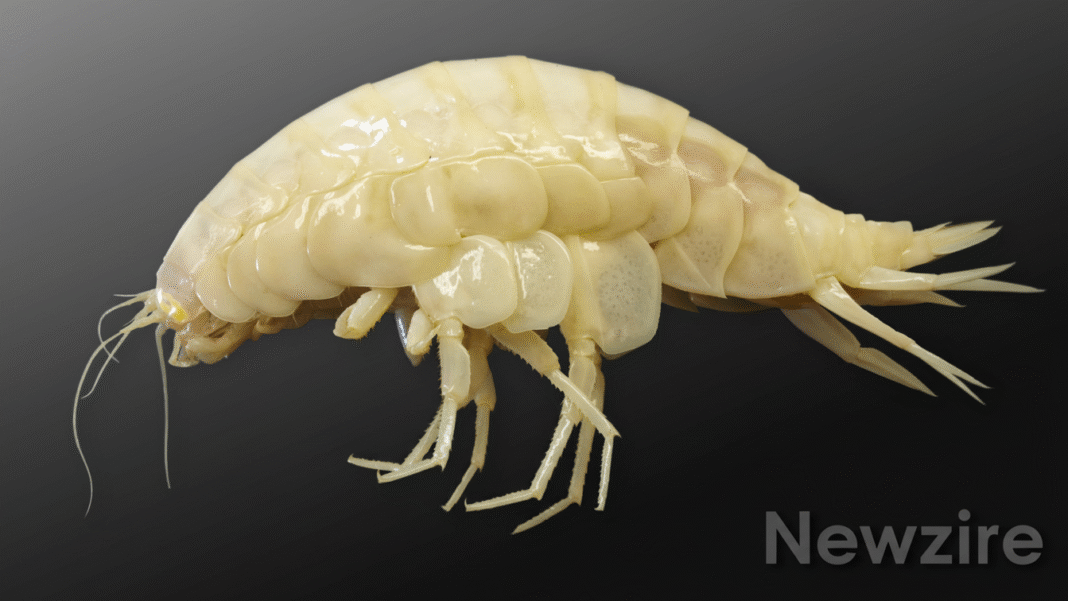
Marine biologists spent over a century convinced Alicella gigantea was one of the rarest creatures in the ocean. The massive crustacean, unpigmented and ghostly white, reaches up to 34 centimetres in length. It turned up so sporadically in research samples that experts assumed it clung to existence in scattered pockets of the abyss.
They were wrong.
Research published in Royal Society Open Science shows this supergiant amphipod occupies nearly 59% of suitable seafloor habitat across the Pacific, Atlantic and Indian Oceans. This overturns a century of assumptions about deep-ocean species distribution and abyssal biodiversity.
Table of Contents
Why Scientists Thought It Was Rare
In 1972, researchers published footage in the journal Science showing an amphipod over 28 centimetres long at 5,304 metres in the North Pacific. Scientists identified it as Alicella gigantea, first described in 1899 from specimens collected off the Canary Islands.
Then nothing. For over 40 years, no further records turned up.
“Historically, it has been sampled or observed infrequently relative to other deep sea amphipods, which suggested low population densities,” said Dr Paige J. Maroni from the University of Western Australia, who led the new research. “And, because it was not often found, little was known about the demography, genetic variation and population dynamics with only seven studies published on DNA sequence data.”
These amphipods live between 3,890 and 8,931 metres below the surface, where water pressure crushes most organisms and temperatures hover near freezing in complete darkness. Few research vessels possess the specialized equipment needed to reach such zones.
Modern Equipment Reveals Hidden Abundance
Baited camera landers found aggregations. When researchers deployed them in the Kermadec Trench in 2012, they recovered nine individuals ranging from 102 to 290 millimetres at depths between 6,265 and 7,000 metres. Video footage captured multiple amphipods swarming bait stations.
Cameras at the Murray Fracture Zone in the North Pacific recorded aggregations of white, shrimp-like creatures converging on bait at 6,500 to 6,700 metres. Baited traps off Japan’s coast caught 61 individuals at 6,200 metres, with a combined weight of 1.1 kilograms. Each averaged roughly 18 grams, heavier than most smartphone models.
Dr Maroni’s team compiled 195 records from 75 locations worldwide. The data came from 18 published studies spanning 15 different seafloor features. New records came from expeditions aboard the DSSV Pressure Drop (renamed RV Dagon), RV Sonne, and RV Mermaid Sapphire.
Collection sites span three oceans:
- Murray Fracture Zone, northeast Pacific
- Kermadec Trench, southwest Pacific
- Mariana, Palau, Santa Cruz, San Cristóbal, Tonga, Ryukyu, Izu Ogasawara and Japan trenches
- Zenith Plateau and Afanasi Nikitin Seamount, Indian Ocean
- New Britain Trench, southwest Pacific
- Multiple Atlantic locations
Sampling has concentrated in the Pacific, leaving the Atlantic and Indian Oceans with fewer records. The Arctic, Antarctic and Mediterranean have yielded nothing.
Global Genetic Analysis Reveals Single Population
The team analysed two mitochondrial genes (16S and COI, which track maternal lineage) and one nuclear gene (28S, inherited from both parents) from specimens collected thousands of kilometres apart. Populations had minimal genetic variation.
A single, shared haplotype persists across roughly 8,000 kilometres, from the Kermadec Trench to the Japan Trench. That distance equals London to Beijing. These creatures, separated by an entire ocean basin, maintain near-identical genetic signatures.
The species feeds on carrion and organic matter that sinks to the ocean floor. Juveniles start with bacteria and zooplankton debris, then switch to larger food sources as they mature. Scavenging works in nutrient poor environments where food arrives sporadically.
Their white colouration breaks the pattern seen in most deep sea amphipods, which typically display red to orange hues. The lack of pigmentation suggests few predators exist at extreme depths. Analysis of radiocarbon signatures shows these amphipods live over 10 years, an unusually long lifespan for crustaceans of their size.
Depth based projections show Alicella gigantea inhabits all six major ocean bodies. The Pacific Ocean holds the most habitat, though uneven sampling influences these estimates, particularly for regions like the Southern Ocean where no physical samples exist. The genetic data shows minimal differentiation, though subtle ecological differences separate groups adapted to specific trenches or fracture zones.
Mining Plans Collide With Discovery
The widespread presence of this hadal zone fauna now intersects with commercial interests. Companies are seeking approval to mine polymetallic nodules from the abyssal plains. The depths they target match exactly where these amphipods live.
A 2022 mining trial in the eastern Pacific demonstrated the impact. A commercial scale machine recovered over 3,000 tonnes of nodules at 4,280 metres, reducing macrofaunal density by 37% within the mining tracks and species richness by 32%. Crustaceans, including amphipods, comprised most of the affected fauna.
“As exploration of the deep sea increases to depths beyond most conventional sampling, there is an ever-growing body of evidence to show that the world’s largest deep sea crustacean is far from rare,” Dr Maroni said.
The International Seabed Authority has set targets to describe over 1,000 species by 2030 in regions targeted by miners. But 90% of the estimated 5,000 species recorded in zones like the Clarion Clipperton Zone remain unnamed and undescribed.
Recovery takes decades. The creatures’ decade long lifespans and dependence on intermittent food sources mean populations need 20 to 30 years to rebound from habitat destruction. Studies have detected human pollutants including DDT and chlordane in specimens, despite their apparent isolation from surface waters.
Pollutants Reach the Abyss
Scientists spent 126 years classifying Alicella gigantea as rare. The species thrives across 59% of suitable ocean floor in three major oceans, surviving at depths that crush most surface dwelling organisms within seconds.
Yet specimens carry traces of DDT and chlordane in their tissue. These pesticides were banned decades ago. The ocean’s most isolated inhabitants, living up to 8,931 metres below the surface in darkness, contain industrial pollutants from human activity.
Mining companies want access to 59% of suitable deep-ocean habitat. That represents roughly 212 million square kilometres of seafloor. Dr Maroni’s findings arrived as regulators prepare to finalize rules opening these depths to extraction. The creature scientists thought was vanishingly rare occupies more territory than all of Earth’s continents combined.