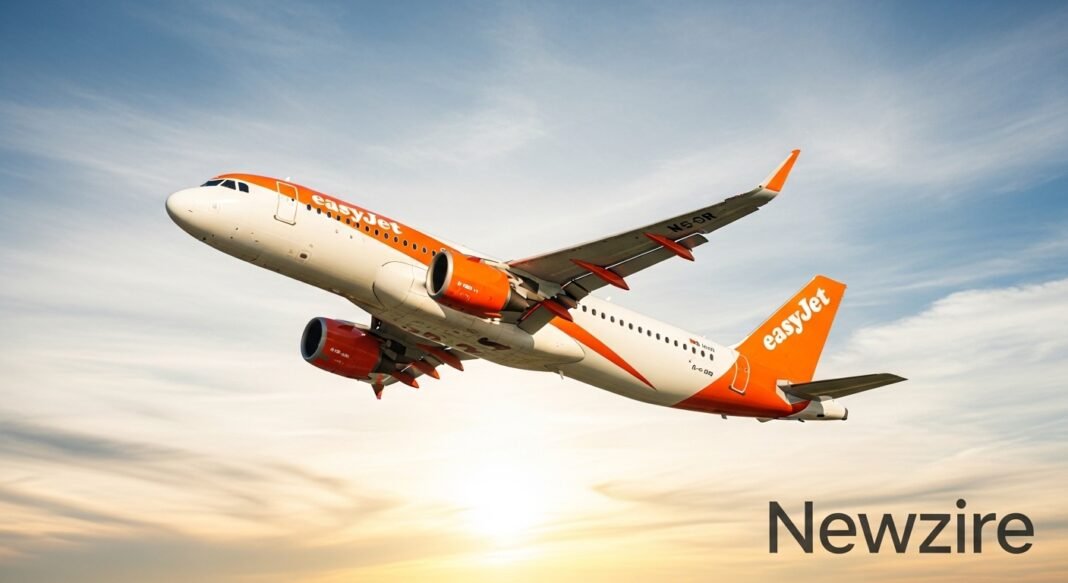
easyJet flight U22058 was on a routine summer crossing from Crete to Manchester on 1 July 2025 when the crew declared an emergency at 38,000 feet over France. A passenger had become seriously unwell. The aircraft landed safely at Paris Charles de Gaulle. No fatalities were reported.
Table of Contents
At a Glance
| Flight | easyJet U22058 |
| Route | Heraklion, Crete (HER) to Manchester (MAN) |
| Date | Tuesday, 1 July 2025 |
| Aircraft | Airbus A320neo — Registration G-UZEF |
| Emergency Code | Squawk 7700 |
| Cause | Passenger medical emergency |
| Diverted To | Paris Charles de Gaulle (CDG) |
| Runway / Terminal | Runway 26R / Terminal 2 |
| Outcome | Safe landing. No fatalities reported. |
Flight U22058: What Happened Over France
U22058 lifted off from Heraklion International Airport “Nikos Kazantzakis” at 20:57 local time (18:57 BST) on 1 July 2025, bound for Manchester on a scheduled crossing that British holidaymakers make from Crete every summer. The aircraft was due into Manchester shortly after 11pm BST.
That did not happen.
Cruising at 38,000 feet over French airspace, the crew activated Squawk 7700 on the transponder. AIRLIVE reported the diversion to Paris CDG at 22:12 BST, with a passenger medical emergency confirmed as the cause.
The aircraft touched down on Runway 26R at Paris CDG at 22:17 BST. By 22:21 BST it was parked at Terminal 2. Aviation tracking account @FlightEmergency on X formally confirmed the medical cause at 22:22 BST, drawing on live AirNav Radar data.
Paris CDG sits at the natural midpoint on the Heraklion-to-Manchester route over French airspace. It operates around the clock and has a dedicated medical centre at Terminal 2 open 24 hours a day, making it the appropriate choice for a medical diversion at that point in the flight.
The identity and nature of the passenger’s condition were not publicly disclosed. That is standard across incidents of this kind.
What Squawk 7700 Actually Means
Squawk 7700 is a term that lit up aviation tracking sites the moment U22058 changed course over France. It is the International Civil Aviation Organisation’s (ICAO) universal general emergency transponder code — the four digits a crew sets when they need every air traffic control facility in the surrounding airspace alerted at once.
The moment it is activated, runways get cleared, emergency vehicles are positioned, and the flight receives absolute priority over all other traffic. The code itself does not specify what is wrong. The crew communicates that separately over radio, which is why initial tracking reports sometimes misidentify the cause before the radio communications become known.
The three reserved ICAO emergency codes are:
| Code | What It Signals |
|---|---|
| 7700 | General emergency of any kind |
| 7600 | Loss of radio contact with ATC |
| 7500 | Unlawful interference or hijacking |
Boeing 757/767 captain Ken Hoke, writing for Flightradar24, has noted that the vast majority of 7700 activations involve crews flagging situations that are abnormal but not catastrophic. On U22058, the code worked exactly as designed: the aircraft was on the ground at Paris CDG within minutes, with emergency services already in position on arrival.
The Aircraft: G-UZEF and Its Short History
The aircraft that made that descent into CDG was G-UZEF, an Airbus A320-251N delivered to easyJet UK in January 2025. At the time of the Paris diversion, it was six months old and among the newest aircraft in the fleet.
The A320neo variant uses CFM International LEAP-1A engines, which cut fuel burn by 15 to 20 percent against the older A320ceo and reduce takeoff noise by roughly half. easyJet UK was operating 50 of them at the time, all in active service. No mechanical fault with G-UZEF was reported in connection with the July diversion. The cause was entirely the passenger’s medical condition.
The same aircraft had already featured in a formally published AAIB serious incident report ten weeks before the Paris diversion. On 20 April 2025, G-UZEF was operating flight U23011 from Belfast to Palma with 177 passengers on board when it failed to pressurise during the climb to FL390. The crew had left the ditching pushbutton selected after preparing for de-icing, which blocked the pressurisation system. The cabin altitude reached a recorded 10,304 feet before the commander identified the fault, initiated an emergency descent to FL200, deselected the pushbutton, and continued safely to Palma. No passengers were injured. The AAIB classified the event as a serious incident and both easyJet and Airbus updated their de-icing checklists as a result.
The April pressurisation failure and the July medical diversion share no common cause. Two separate events, same airframe.
One in 212 Flights: How Often Does This Actually Happen?
More often than most passengers would think.
A study published in JAMA Network Open in September 2025, conducted with MedAire across 77,000 in-flight medical events from 84 airlines, is the largest analysis of its kind ever carried out. Its findings put incidents like U22058 into clear perspective:
- 1 in every 212 commercial flights involves a medical emergency of some kind
- Only 1.7% of those cases are serious enough to result in a diversion
- Around 8% of passengers involved in in-flight emergencies are taken to hospital after landing
- The most common triggers for an actual diversion: suspected stroke, seizures, chest pain, and altered mental status
- Medical volunteers, often doctors travelling as passengers, assist in roughly one in three of all in-flight medical events
The U22058 diversion sits in that 1.7%. Once the onboard assessment determined that ground-level care was needed, landing was the only option.
easyJet dealt with a near-identical situation three months later, when a passenger fell seriously ill over the North Sea on the Copenhagen to Manchester service. The crew again squawked 7700 and diverted, this time to Newcastle Airport. That full account is reported here.
Were Passengers on U22058 Entitled to Compensation?
Anyone who landed in Paris instead of Manchester on 1 July 2025 would want a straight answer on this.
Under UK261 and EU Regulation 261/2004, a passenger medical emergency is classified as an extraordinary circumstance. The flight departed from an EU airport on a UK carrier, placing it under both frameworks. For passengers on U22058, that classification meant:
- No fixed-rate cash compensation is owed for being diverted to Paris or for the delay in reaching Manchester
- Meals and refreshments must be provided during any significant wait at CDG
- Hotel accommodation must be arranged if the delay runs overnight
- Rebooking onto the next available service to Manchester is required at the airline’s cost
easyJet did not issue a public statement specifically addressing the U22058 incident. For medical diversions of this kind, that is not unusual.
30 Years, Zero Fatalities: easyJet’s Safety Record
easyJet has not recorded a single fatal accident across 30 years of continuous operations since launching in 1995. The airline holds a 7-out-of-7 safety rating on AirlineRatings.com and was ranked the second safest low-cost carrier worldwide in 2024, as reported by Euronews.
On U22058, the crew identified the emergency, activated the correct code, coordinated with ATC, selected an appropriate airport, and landed safely. No part of that process failed.
The same flight number was in the news again on 6 August 2025, when a different aircraft, the older G-EZTJ (Airbus A320-200), operated the identical Heraklion to Manchester route and squawked 7700 over France for a completely separate reason: a hydraulic leak. That aircraft also diverted to Paris CDG, was grounded for inspection and repairs, and again no passengers were injured.
Across that same summer, easyJet dealt with at least one further serious diversion when flight U22152 diverted to Cologne in August 2025 after the first officer was taken ill over Germany with 185 people on board. The captain completed the diversion and landed safely.
Three separate incidents, across three different aircraft, on three different dates. All ended safely.
Sources: AIRLIVE | Aviation Source News | UK AAIB Report — GOV.UK | Flightradar24 — Squawk 7700 Explained | Duke Health / JAMA Network Open | Euronews / AirlineRatings