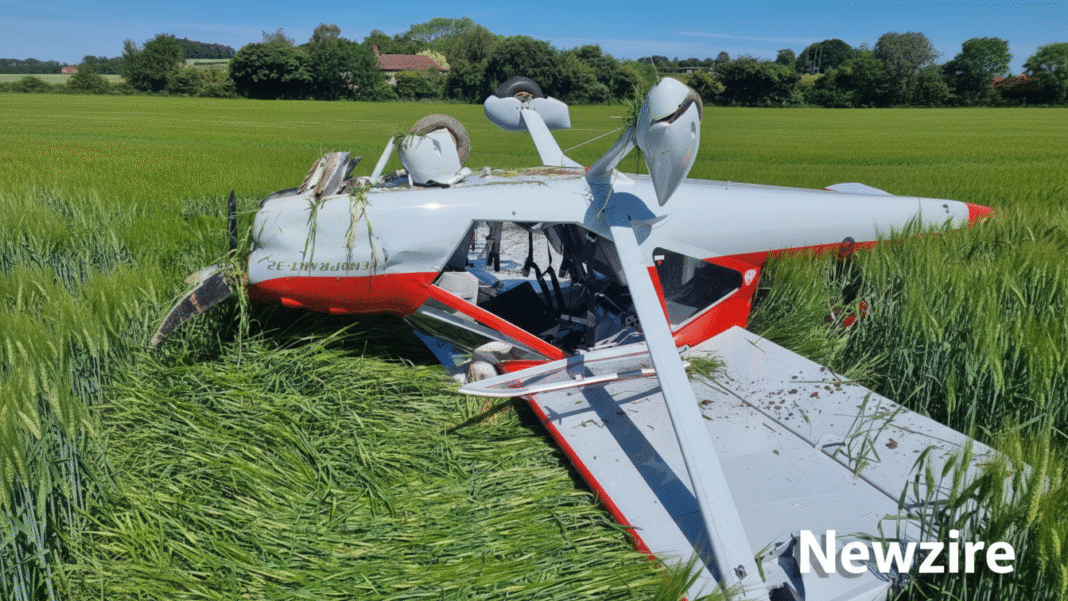
A pilot executed an emergency landing in a Norfolk cornfield after turbulence at Cromer damaged his Aeroprakt A32 Vixxen and jammed the flight controls during a second approach attempt on June 20, 2024.
The light aircraft overturned when its landing gear caught in the crop, but both the 69 year old pilot and his passenger escaped with minor injuries.
Table of Contents
Heavy Nosewheel Impact Jams Flight Controls During Second Approach
The flight from Nottingham City Airport to the grass airfield near Cromer started normally that Thursday morning. Surface winds were easterly at 8 knots when the pilot lined up for a straight in landing on Runway 04.
Trees at the runway threshold created turbulence that destabilised the first approach, prompting a go around and second attempt.
On the next approach, the plane encountered turbulence again, but this time it caused rapid descent. He applied power and rudder to correct the disturbance but could not prevent the light sport aircraft from hitting the ground nose first.
After the hard impact, he initiated a baulked landing and climbed away. That’s when he discovered the rudder pedals were completely jammed.
Steerable Nosewheel Connection Leaves Pilot Without Directional Control
On the Aeroprakt A32 Vixxen, the steerable nosewheel connects to the rudder pedals through pushrods. When the nose gear struck hard, damage to the steering assembly locked the flight controls, leaving the pilot unable to steer the aircraft on the ground or control the rudder in flight.
The pilot had 1,711 hours total flying experience, including 32 hours on type, and faced an immediate decision. The Air Accidents Investigation Branch report documents three options he considered:
- Divert to an airfield with a longer, more into wind runway
- Use the aircraft’s ballistic parachute recovery system
- Land immediately in a suitable field
Diverting was ruled out due to concerns the damaged nose leg would collapse on touchdown with unpredictable consequences. The aircraft had a ballistic parachute system that uses a rocket to deploy within seconds, lowering the entire plane to the ground. He was unwilling to use it because the outcome would be “unknown.”
With his passenger becoming increasingly distressed, he chose an immediate precautionary landing.
Pilot Selects Cornfield for Controlled Slow Speed Touchdown
The commander identified a field nearby and set up his approach aligned with the furrows. With full flap extended, he turned off the fuel and battery master switches just before touchdown.
The 2023 aircraft, powered by a 100 horsepower Rotax 912iS engine, touched down as close to stall speed as possible. As the landing gear snagged in the corn, the plane cartwheeled onto its back.
Both occupants were able to exit the inverted aircraft without assistance. The airframe and propeller sustained substantial damage.
Investigation Confirms Unexpected Sink Caught Experienced Pilot Off Guard
He told investigators he anticipated turbulence over the trees on the second approach because he had experienced it earlier. What caught him off guard was the associated sink.
“Having experienced it earlier, he was expecting turbulence over the trees on the second approach but was caught out by the associated sink, which had not been a feature of the first approach,” the AAIB report states.
Despite the rapid descent, he judged that increasing power would be sufficient to correct the approach path. Rather than initiating a second go around, the approach continued to landing.
The BBC reported on the inverted aircraft discovery in the Norfolk countryside when the incident first came to public attention in August 2024.
Emergency Decision Making at Grass Strip Airfields
He maintained his view that landing as slow as possible in the cornfield achieved a more predictable and safer outcome than using the parachute system or attempting to land on a hard runway with compromised nose gear.
The incident demonstrates how turbulence near obstacles can cascade into control failures at grass airfields, where pilots have seconds to choose between uncertain options. The investigation found no criticism of the pilot’s emergency handling, with both occupants surviving what could have been a more serious accident.
The G-RASP incident remains a case study in emergency decision making when turbulence and mechanical failure combine at grass strip operations, with the pilot’s choices proving critical to the survival of both occupants.