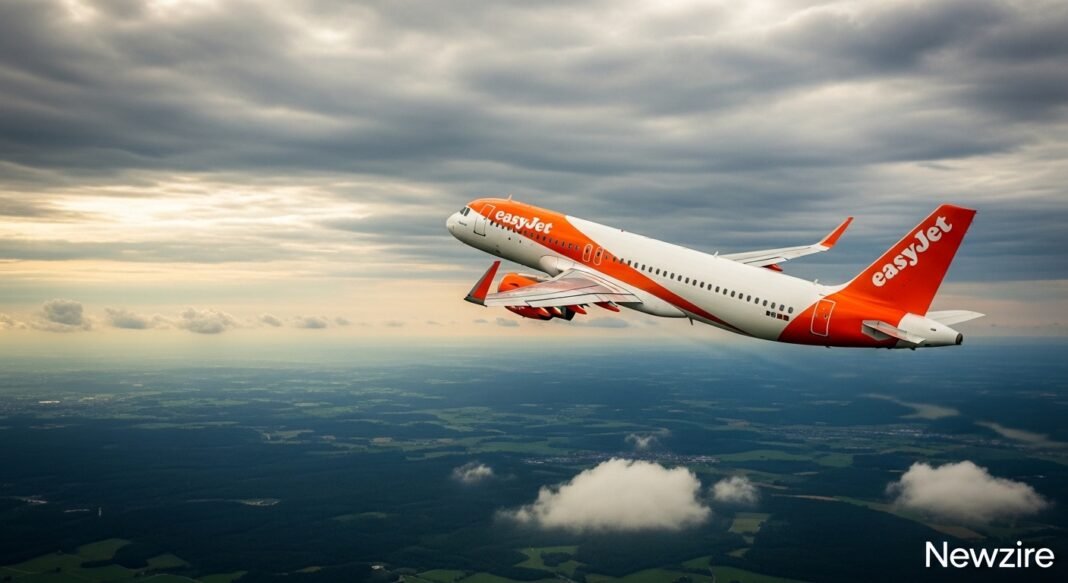
An easyJet flight from Istanbul was less than two hours from Manchester when the first officer collapsed in the cockpit over Germany. The captain declared an emergency, turned toward Cologne, and put the aircraft down safely with 185 people on board. Those passengers would not reach Manchester until the early hours of the following morning, nearly eight hours after they were due to land.
Table of Contents
At a Glance
| Detail | Information |
|---|---|
| Flight | EZY2152 / U2-2152 / U22152 |
| Route | Istanbul Airport (IST) to Manchester (MAN) |
| Date | Friday, 15 August 2025 |
| Aircraft | Airbus A320-214(SL), registration G-EZRX |
| Souls on Board | 185 |
| Emergency | First officer incapacitated, food poisoning suspected |
| Diverted To | Cologne/Bonn Airport (CGN), Germany |
| Actual Delay at Manchester | Approximately 8 hours |
What Happened on EZY2152 Over Germany
Flight U22152 was cruising at FL360 (36,000 feet), roughly 150 nautical miles east-southeast of Cologne, when the captain made the call to divert.
The first officer had become incapacitated with severe stomach pain. Food poisoning was suspected, though no hospital confirmation has ever been made public and easyJet’s own statement did not name a cause.
At 15:41 UTC, live aviation tracking platform Airlive.net detected the aircraft broadcasting squawk 7700, the internationally recognised emergency transponder code. When those four digits appear on a radar screen, every air traffic control facility monitoring that airspace is alerted at once. The captain also communicated directly with German ATC, who cleared a priority path to Cologne.
According to The Aviation Herald, a specialist aviation incident tracking publication, the aircraft touched down on Cologne’s runway 32R roughly 27 minutes after the diversion decision was made.
easyJet confirmed the incident to the Manchester Evening News:
“Flight EZY2152 from Istanbul to Manchester diverted to Cologne due to a crew member onboard requiring urgent medical assistance. The crew member was met by medical services and the flight will continue to its destination later this evening. The safety of our customers and crew is always easyJet’s highest priority.”
The airline used the phrase “crew member” rather than specifying the role. Aviation Herald’s incident report, published two days later, confirmed the affected person was the first officer.
Why Tracking Sites Reported a Pressurisation Problem First
When Airlive picked up the squawk 7700 signal at 15:41 UTC, the initial read from flight tracking data was a cabin pressurisation emergency.
The confusion has a straightforward explanation. A pressurisation event requires a rapid descent to around 10,000 feet, which produces the same altitude drop on a tracker as an approach for a medical diversion. The real cause only becomes clear once the crew’s radio communications with ATC are known.
By 15:55 UTC, with the aircraft already on approach into Cologne, Airlive corrected the record: the diversion was due to a crew medical emergency, not a pressurisation fault.
Boeing 757/767 captain Ken Hoke, writing for Flightradar24, is worth quoting on this point: “99% of the emergencies observed on websites like FlightRadar24 are very benign events.” A 7700 squawk is not a crash alert. It is the crew telling ATC they have something abnormal on their hands and need priority handling.
EZY2152: The Corrected Timeline and Eight-Hour Delay
Several outlets put the Manchester delay at five or six hours. The actual figure, calculated from verified flight data, is close to eight hours.
| Time (UTC) | Event |
|---|---|
| 12:00 | Scheduled departure, Istanbul |
| 13:17 | Actual departure, Istanbul (already 1hr 17min late) |
| 15:41 | Squawk 7700 detected, aircraft at FL360 over Germany |
| 15:55 | Airlive corrects initial report: crew medical emergency confirmed |
| ~16:00 | Aircraft lands at Cologne/Bonn Airport, runway 32R |
| 16:00 to 23:10 | Approximately 7 hours on the ground at Cologne |
| 23:10 | Departs Cologne with replacement pilot |
| 00:19 (16 Aug) | Arrives Manchester, 7hr 59min late |
Scheduled arrival in Manchester was 16:20 UTC (17:20 BST). The aircraft arrived at 00:19 UTC the following morning.
One passenger on the flight, Ali Ahmed, posted on the Airlive Facebook thread: “I was on the flight and we were delayed by 6hrs. It turned out one of the flight crew had food poisoning.” His six-hour figure is a rounded recollection. The flight data puts the actual delay just under eight hours.
What happened to the 185 passengers during those seven hours on the ground at Cologne is not confirmed in any public record. Questions were raised in the Aviation Herald reader comments section after the report was published, with one passenger asking whether travellers were kept on board throughout. A separate commenter estimated the actual time spent inside the cabin was closer to two hours, suggesting passengers may have been deplaned at some point during the ground stop. easyJet released no public statement about what care or facilities were provided to passengers at Cologne.
G-EZRX: Two Emergency Diversions in Two Years
A number of reports circulating online have incorrectly identified the aircraft involved as G-EZWT. The correct registration, confirmed by Aviation Herald, Airlive, and all major flight tracking databases, is G-EZRX.
That registration carries its own history.
On 8 June 2023, the same Airbus A320 was operating flight U2-2143 from Manchester to Dalaman when the captain became incapacitated at approximately 35,000 feet. The first officer declared a Mayday and performed an emergency landing at Split Airport in Croatia.
easyJet confirmed at the time: “The First Officer performed a routine landing in accordance with standard operating procedures, and the aircraft was met by emergency medical services upon arrival in Split.”
Simple Flying reported the full Split diversion after the incident. A replacement crew was dispatched to Split and the aircraft continued to Dalaman the same night.
Within two years, G-EZRX was involved in two separate pilot incapacitation events on routes through Manchester. First the captain went down, then the first officer. Neither medical event was caused by the aircraft. Both are on the public record.
The Crew Meal Rule: Why the Captain Was Unaffected
There is a standing safety practice across most airlines: the captain and first officer eat different meals on every flight.
The reasoning is straightforward. If both pilots consume the same contaminated dish, both could become unwell at the same time. Separate meals cut that risk.
SKYbrary, the EUROCONTROL-backed aviation safety database, states this directly: pilots should eat different meals and should eat at different times, with a gap of at least 30 minutes between crew mealtimes recommended.
This is not a formal EASA or FAA requirement. Airlines set it as standard operating procedure and most major carriers follow it.
On flight U22152, only the first officer was taken ill. The captain was unaffected and flew the diversion safely. If the meal separation rule was followed, the outcome is exactly what that rule was built to produce.
For wider context: the UK Civil Aviation Authority recorded 49 cases of pilot incapacitation on public transport aircraft between 1992 and 1997. According to SKYbrary’s pilot incapacitation data, 27 of those 49 cases involved nausea and gastric trouble, making stomach illness the single largest category across all types of pilot incapacitation recorded in that period.
The first officer’s condition following hospital treatment in Cologne was not publicly disclosed. easyJet released no information about their recovery or return to flying duties.
Why the Captain Chose Cologne Over Frankfurt or Dusseldorf
With one pilot down and 185 people on board, the captain needed the closest suitable airport, not the largest one. Cologne met every requirement:
- The aircraft was already closest to Cologne, making it the lowest-risk option in terms of flight time with the captain alone on the flight deck
- Cologne/Bonn Airport (ICAO: EDDK) operates 24 hours a day, seven days a week, one of the few German airports that does
- Its main runway 14L/32R stretches to 3,815 metres, more than sufficient for a loaded A320
- The airport has an on-site medical centre and full emergency response capability
- It sits just 14.8km from Cologne city centre, giving fast access to hospital facilities
Frankfurt and Dusseldorf are both larger airports. Neither offered anything Cologne did not, and both would have meant more time in the air with only one pilot at the controls.
Passenger Compensation: What UK261 Actually Says
Passengers on U22152 who arrived in Manchester nearly eight hours late would understandably want to know whether they were owed compensation. Under UK261 and EU Regulation 261/2004, the answer for this specific flight is no.
Crew medical emergencies are classified as extraordinary circumstances. Airlines are not required to pay fixed-rate delay compensation when a diversion is caused by a sudden medical event outside their control.
What the airline is required to do is provide care during any significant wait, including food, water, and access to communication at minimum. As noted above, whether passengers on U22152 received that care during the seven-hour Cologne ground stop was never confirmed in any public statement from easyJet.
Claims circulating online suggest easyJet automatically paid EU261 compensation to all passengers on U22152. That is not supported by any verified source, by easyJet’s public statements, or by UK261 law as it applies to medical emergency diversions.
EasyJet Medical Diversions: A Pattern Across UK Routes
The Cologne diversion was not a standalone event. From mid-2024 through late 2025, easyJet dealt with several medical emergency diversions on routes to and from the UK:
- July 2024: A first officer lost consciousness on the London Luton to Lisbon route. The captain executed a safe landing at Lisbon Airport, where emergency services were waiting on the ground.
- February 2025: The captain was incapacitated on the Hurghada to Manchester flight. The first officer diverted to Athens, where medical teams met the aircraft on arrival.
- August 2025: The first officer on flight U22152 became incapacitated over Germany, prompting the Cologne diversion covered in full above.
- October 2025: A passenger fell seriously ill over the North Sea on the Copenhagen to Manchester service, prompting a squawk 7700 declaration and a diversion to Newcastle Airport. The passenger was taken to the Royal Victoria Infirmary before the flight continued to Manchester. The full account of that diversion is reported here.
Not one of these incidents resulted in passenger injuries. In each case, the remaining pilot declared an emergency, followed procedure, and landed safely.
As of March 2026, no formal investigation report has been published by the UK Air Accidents Investigation Branch or Germany’s Federal Bureau of Aircraft Accident Investigation for the U22152 incident. For a crew incapacitation that did not result in an accident, that is not unusual.
easyJet holds a 7/7 safety rating from AirlineRatings.com and was ranked the second safest low-cost airline worldwide in 2024. Its fatality-free record remained intact after Cologne.
The 185 passengers on U22152 had a long Friday night. The first officer needed hospital treatment. The captain flew the aircraft down alone in a foreign country. Everyone got home.
Sources: Aviation Herald | Airlive.net | Manchester Evening News via Yahoo News | SKYbrary Food Poisoning | SKYbrary Pilot Incapacitation | Flightradar24 Squawk 7700 | Simple Flying G-EZRX Split 2023