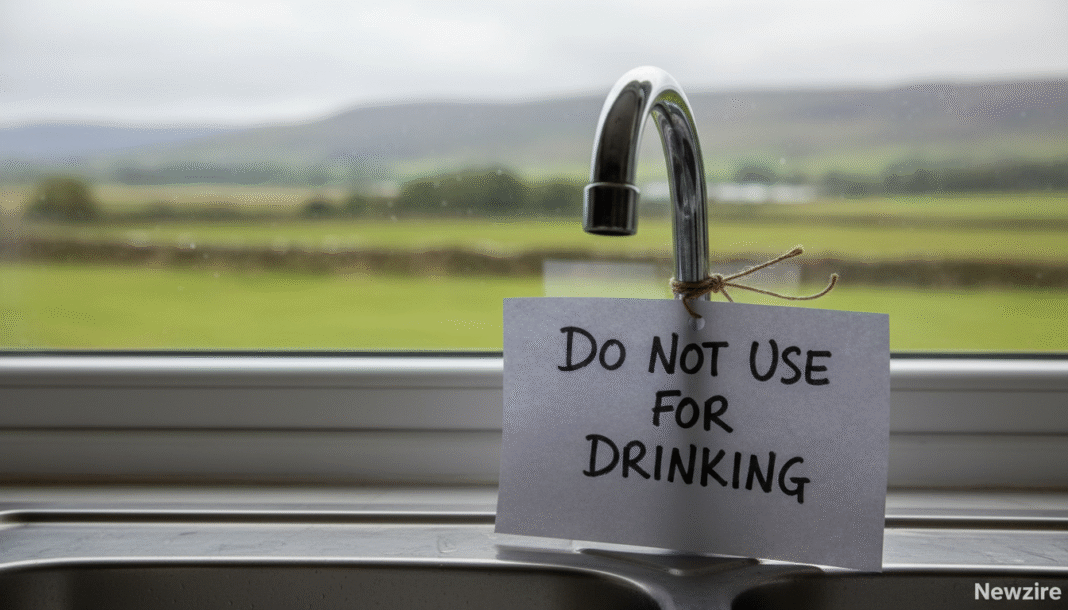
Six thousand homes and businesses across Berwickshire had no running water for up to five days after a burst pipe at Rawburn Water Treatment Works caused a supply failure across thirteen communities in the Scottish Borders.
The crisis began on Tuesday 26 August 2025 and was not fully resolved until Sunday 31 August. A formal DO NOT DRINK notice was issued to around 300 properties and lifted within 24 hours. The wider supply outage, which cut off thousands more homes, ran on for five days and eventually reached the floor of the House of Commons.
This incident has since been resolved. Full supply was restored across all affected areas by 31 August 2025.
Table of Contents
At a Glance
| Incident started | Tuesday 26 August 2025 |
| DO NOT DRINK notice issued | Around 300 properties — lifted 27 August 2025 |
| Total properties affected | Up to 6,000 |
| Communities affected | 13 across Berwickshire |
| Full supply restored | Sunday 31 August 2025 |
| Duration | Five days |
| Tankers deployed | 20+, running 24 hours a day |
| Bottles distributed | Around 100,800 |
| Compensation offered | £45 per eligible property |
The full account below covers what caused the failure, which communities were cut off, what the tap water warning meant in practical terms, and what compensation Scottish Water offered to those affected.
What Caused the Water Supply Failure in Berwickshire
On the afternoon of Tuesday 26 August 2025, Scottish Water engineers found serious damage inside Rawburn Water Treatment Works, a facility in the Lammermuir Hills near Longformacus. Early reports described the pipe as “disintegrated.” Water quality in the supply area fell below what Scottish Water describes as its “normally high standard.”
The utility issued a formal DO NOT DRINK notice to around 300 properties in the TD11 postcode area and sent teams door-to-door that same evening, delivering bottled water and written notices in person.
Then came the decision that widened the crisis to a far larger scale.
To carry out emergency repairs, Scottish Water shut the entire treatment works down. Rawburn normally pumps up to seven million litres of water per day through nine storage tanks and around 370 miles of water mains to more than 10,000 properties across Berwickshire. Once the works went offline, that network started draining.
By Wednesday morning, large parts of Berwickshire had no running water at all.
Which Areas in Berwickshire Were Affected
At peak disruption, the supply failure hit up to 6,000 properties across these thirteen communities:
- Duns
- Chirnside
- Coldstream
- Coldingham
- Eccles
- Paxton
- Burnmouth
- Lamberton
- Drone Hill
- Birgham
- Whitsome
- Swinton
- Leitholm
Postcodes TD5, TD10, TD11, TD12, TD13, TD14 and TD15 all saw some level of disruption. Most of these are rural Borders communities, many miles from the nearest supermarket, which made sourcing alternative bottled water far harder than it would have been in an urban area.
Some residents lost supply completely. Others saw low pressure or intermittent flow depending on where they sat in the network. Scottish Water confirmed that without the emergency tanker operation it mounted from Wednesday onwards, nearly 10,000 properties could have been cut off.
What the Berwickshire DO NOT DRINK Notice Meant in Practice
The formal tap water warning applied to the approximately 300 properties fed directly from Rawburn WTW. Scottish Water told those households not to use tap water for:
- Drinking
- Cleaning teeth
- Preparing baby feeds or sterilising baby equipment
- Preparing any food, including ice cubes and salads
- Pet food or water
- Washing open wounds
The same tap water was still safe for bathing, showering, washing dishes, laundry and flushing toilets.
The DO NOT DRINK notice was lifted on the evening of Wednesday 27 August, less than 24 hours after it was issued. The wider supply outage across 6,000 properties was a separate problem — and took considerably longer to resolve.
One practical note Scottish Water issued for when supply did return: if water came back discoloured or with particles, residents were advised to run the cold kitchen tap at low pressure until it ran clear.
The Scale of the Emergency Response
Scottish Water described its own response as “almost military” in scale — though many residents and local politicians argued that the scale of the disruption showed the response had come too late for thousands of households who went without water for days before deliveries reached them.
Scottish Water’s full account of the operation sets out what was deployed across the affected areas.
| Resource | Deployed |
|---|---|
| Water tankers | 20+, running 24 hours a day |
| Additional staff | 100+, including volunteers from other teams |
| Specialist equipment | Pumps, pipes and control systems from Aberdeen and Glasgow |
| Water transported by road | 12 million litres |
| Bottled water distributed | 210 pallets — around 100,800 bottles — 201,600 litres |
| Doorstep deliveries | 1,600 |
| Bottled water collection points | 15 across Berwickshire |
| Live updates posted online | 30+ during the incident |
The main collection point was the car park at Berwickshire High School in Duns. A dedicated farm task team was set up on Thursday 28 August specifically to deliver water to farms where animal welfare had become a concern.
Scottish Water’s Water Operations General Manager, John Griffen, explained why getting supply back took as long as it did:
“This is a big rural network and when it empties, it takes time to refill. It’s not like a power outage when power is either off or on. We are dealing with a product that has to travel huge distances. That’s why some people were without water longer than anyone would want.”
“It’s a Disaster”: The Reaction Across Berwickshire
Anger built quickly across the affected communities — and not only because taps had run dry.
Bottled water deliveries did not reach some communities until two full days after the fault first emerged. MP John Lamont visited Birgham near Coldstream on Thursday morning and said publicly it was “a disgrace that many residents without water have not been delivered bottled water.”
By that point, vital services had been cut off too. Lamont told the Border Telegraph:
“There are still thousands of people without water and now vital services such as Coldstream Medical Centre have lost their supply. I’ve made it absolutely clear to Scottish Water that this is totally unacceptable. It is a disaster and they need to get it sorted out as soon as possible.”
Businesses across the affected areas took a direct hit. A Duns childcare service, a Duns charity shop, a Coldstream soft play centre and the historic Paxton House all closed. Shop shelves were stripped of bottled water across the area.
Scottish Water later acknowledged publicly that it had fallen short on communications. Griffen said:
“We know we didn’t get everything right. We posted over 30 website updates and used social media and the press, but we couldn’t always give exact times for restoration. That’s frustrating and we understand why some people felt they hadn’t been as well informed as expected.”
The BBC’s reporting from day four of the crisis captured how much disruption remained at that point, with around 200 homes and businesses still without water and Scottish Water recharging the network slowly to avoid causing further damage.
Raised in the House of Commons
On 4 September 2025, Lamont took the matter to the House of Commons, telling MPs:
“Thousands of residents in the Scottish Borders were left without water for days, and terrible communication by Scottish Water made matters worse. We were facing a public health crisis, as well as an animal welfare crisis.”
He called for a full Scottish Government investigation and for Scottish Water executives to be held to account. UK Environment Secretary Steve Reed agreed that the SNP Government should be taking a far tougher line.
Scottish Water Compensation for Berwickshire Residents
After the incident, Scottish Water wrote to all affected properties setting out what residents could claim under its Code of Practice.
£45 per eligible property
- £30 for the first 12 hours of unplanned supply interruption
- £15 for the additional 12 hours
Letters went out to roughly 6,000 affected properties. By mid-September 2025, only around 900 households — approximately 15% — had submitted a claim. Scottish Water put the low uptake partly down to difficulties accessing the online claims form.
To address this, the company ran a door-to-door compensation drive from 18 to 28 September 2025, deploying more than 30 staff across affected communities alongside mobile information units at seven locations in Berwickshire.
To claim or check eligibility:
- Online: Scottish Water Berwickshire compensation information
- Email: customer.concerns@scottishwater.co.uk
Scottish Water also warned residents that its staff would never ask for bank details when visiting at the door. Anyone asking for account information while claiming to represent Scottish Water was not a genuine representative.
Where Things Stand Now
Scottish Water confirmed in September 2025 that it had launched a full investigation into the cause of the pipe failure, alongside an internal review of how its communications were handled during the five-day outage.
As of the last confirmed public reporting, no findings from either review have been released. The root cause of the failure — why the pipe failed, and whether it could have been prevented — has not been officially confirmed.
Griffen, addressing customers in Scottish Water’s post-incident statement, said:
“Scottish Water’s customers will always be our top priority and we fully appreciate the inconvenience this incident caused and thank them again for their patience and understanding. Incidents of this scale and duration are rare and highlight how reliable our normal service is. The company is owned by its customers and we will keep listening, learning, and improving for our customers.”
Whether the internal review produced any changes to how Scottish Water monitors and manages its Borders network remains unknown from the public record.
For live service updates from Scottish Water across your area, visit scottishwater.co.uk/in-your-area.
Frequently Asked Questions
Was Berwickshire tap water safe to drink during the August 2025 warning?
Scottish Water confirmed that at no point was there a risk to public health from consuming the water. The DO NOT DRINK notice issued to around 300 properties in the TD11 area was a precautionary measure, not a response to detected contamination.
Which areas in Berwickshire were affected by the 2025 water outage?
Thirteen communities were affected at peak disruption: Duns, Chirnside, Coldstream, Coldingham, Eccles, Paxton, Burnmouth, Lamberton, Drone Hill, Birgham, Whitsome, Swinton and Leitholm. Postcodes TD5 and TD10 through TD15 all saw some level of disruption.
Can Berwickshire residents still claim Scottish Water compensation for the 2025 outage?
Scottish Water offered £45 per eligible property and ran a claims drive through September 2025. Residents can contact Scottish Water directly at customer.concerns@scottishwater.co.uk to check whether a claim can still be submitted.